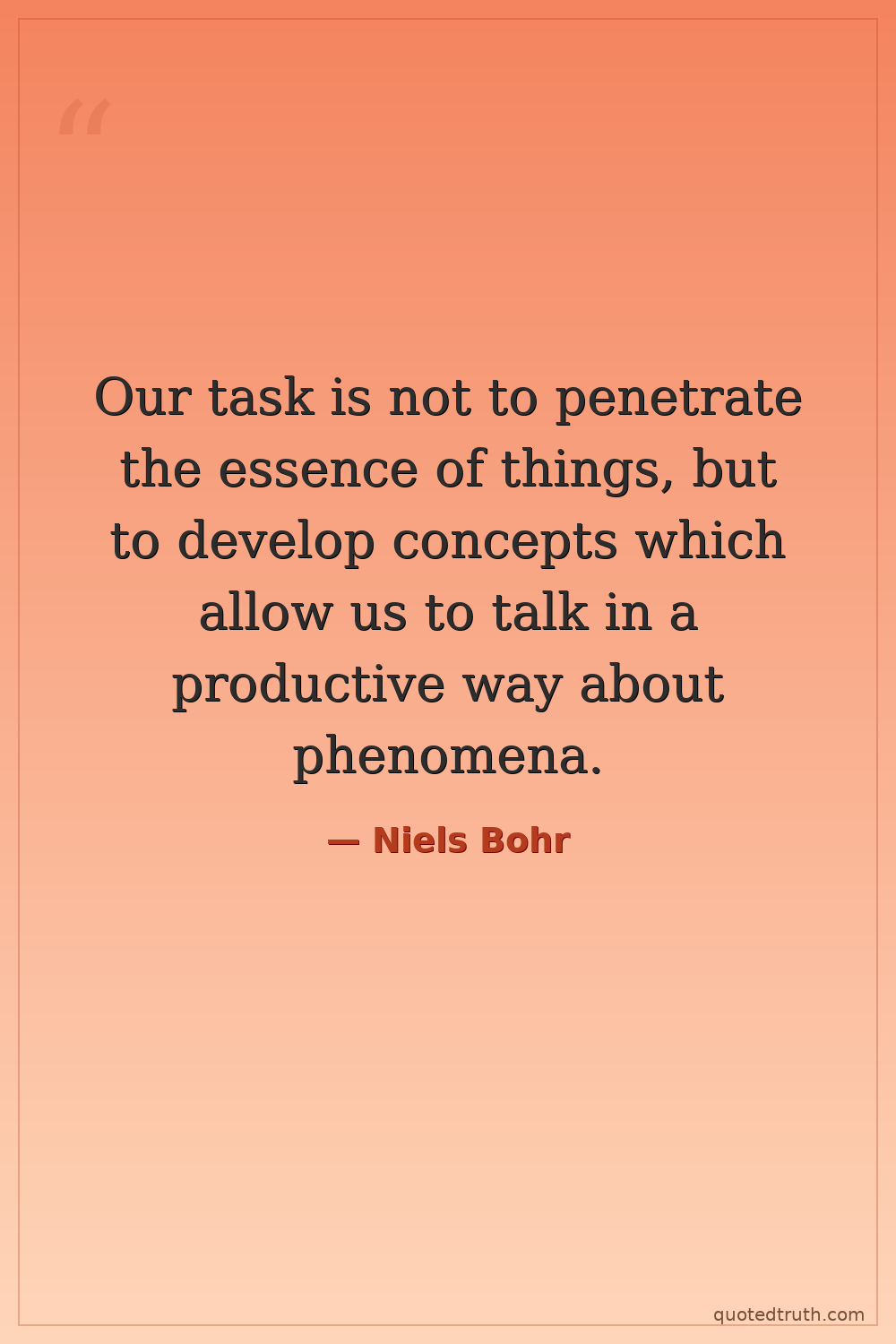
Niels Bohr — "Our task is not to penetrate the essence of things, but to develop concepts whic…"
Our task is not to penetrate the essence of things, but to develop concepts which allow us to talk in a productive way about phenomena.
Our task is not to penetrate the essence of things, but to develop concepts which allow us to talk in a productive way about phenomena.
Click any product to generate a realistic preview. Up to 3 at a time.
* Initial load can take up to 90 seconds — revising the preview in another color is nearly instant.
"Physics is an attempt to describe the world, and it is impossible to describe the world without describing ourselves."
"The electron is an elementary particle, but it is not a 'thing' in the usual sense of the word."
"Stop telling God what to do with his dice."
"The task is not so much to see what no one has yet seen, but to think what nobody has yet thought, about that which everybody sees."
"The great challenge of quantum theory is not to understand how it works, but to accept that it works."
Found in 1 providers: grok
1 source checked
We cannot discover the ultimate nature of reality itself, only build useful mental frameworks that let us describe and predict what we observe. Science is not about uncovering hidden metaphysical truths but about creating practical conceptual tools that work — that generate accurate predictions, enable communication, and open new avenues of inquiry about observable phenomena.
Bohr's entire career embodied this philosophy. His 1913 atomic model was openly provisional — a useful scaffold, not absolute truth. His Copenhagen Interpretation of quantum mechanics argued that asking what an electron 'really is' between measurements is meaningless; only measurable outcomes matter. His debates with Einstein centered precisely on this: Bohr insisted physics describes phenomena, not underlying reality.
The early 20th century shattered classical physics. Quantum mechanics revealed that electrons exist in superposition, measurement disturbs systems, and determinism breaks down at small scales. Scientists faced a crisis: their models worked brilliantly but defied intuitive reality. Bohr's pragmatic epistemology offered a way forward — abandon the quest for absolute truth, embrace useful description — reshaping how scientists understand the purpose of scientific theory itself.
AI-generated insights based on extensive research and information for context. Factual errors? Email [email protected].
Your cart is empty