James Watson — "People say it would be terrible if we made all girls pretty. I think it would be…"
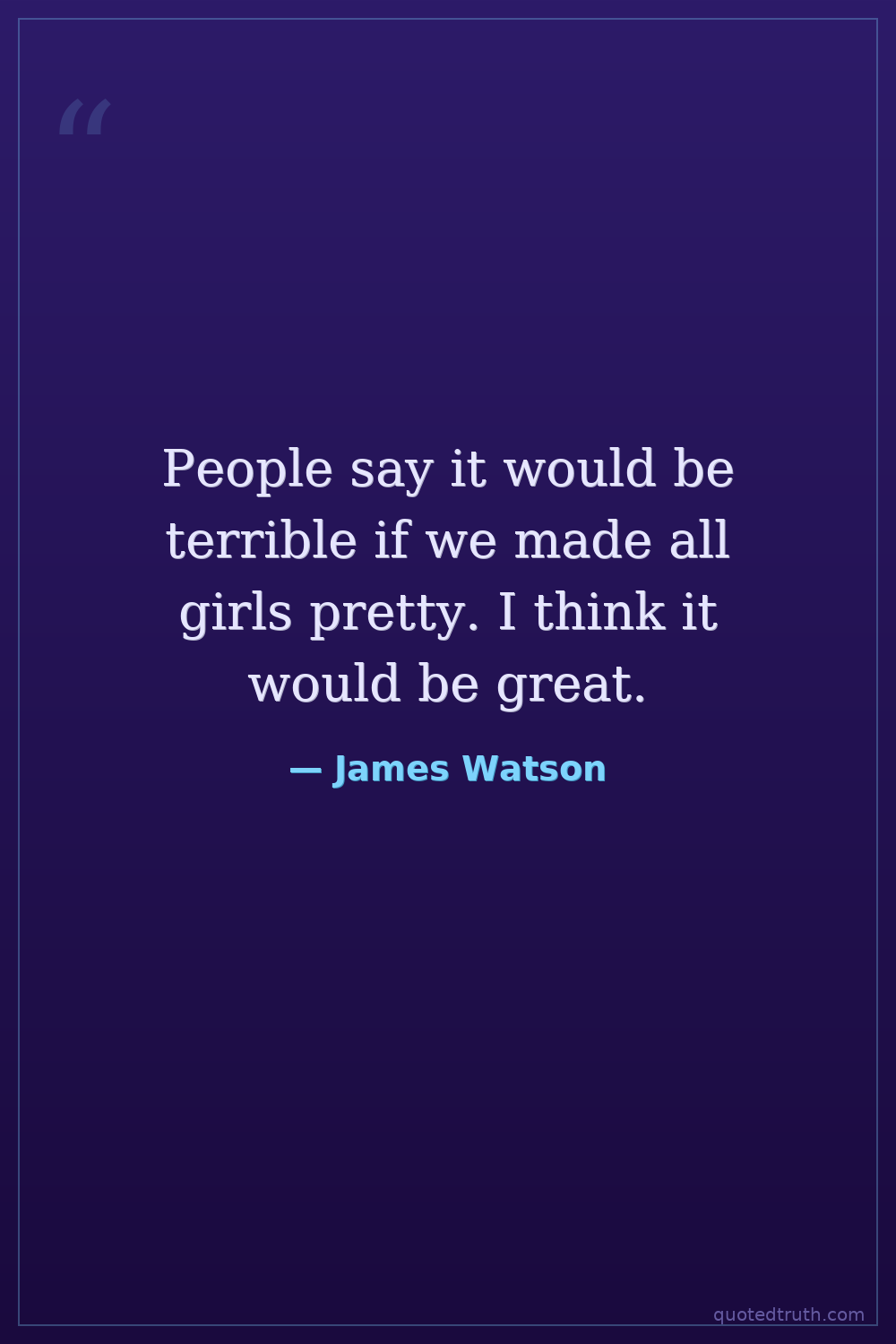
People say it would be terrible if we made all girls pretty. I think it would be great.
People say it would be terrible if we made all girls pretty. I think it would be great.
Click any product to generate a realistic preview. Up to 3 at a time.
* Initial load can take up to 90 seconds — revising the preview in another color is nearly instant.
"Some people say that I am a racist. I am not a racist. I don't see myself as a racist. I don't see myself as a sexist."
"The biggest advantage of having ugly children is that you can be sure they’re yours."
"I don't believe in political correctness."
"Some people think that if you talk about race, you're a racist. I don't think so."
"If you're really stupid, I would call that a disease."
Found in 1 providers: deepseek
1 source checked
Watson is suggesting that genetic engineering should be used to make women more physically attractive, dismissing moral objections as misguided. He frames what critics call eugenics as straightforwardly beneficial — a net improvement for humanity. The quote reveals a utilitarian attitude toward redesigning human traits, treating appearance as a biological problem with an obvious technical fix rather than a complex social and ethical question.
Watson co-discovered DNA's double helix in 1953, giving him a lifelong platform on genetics. He consistently pushed beyond pure science into advocacy for genetic enhancement of human traits. He was stripped of honorary titles at Cold Spring Harbor Laboratory in 2019 after doubling down on controversial views linking race and intelligence. This quote fits a pattern: Watson believed scientific knowledge about genes obligated society to act on it.
Watson made this remark as genetic technology was accelerating rapidly — the Human Genome Project completed in 2003, and CRISPR gene-editing emerged by the 2010s. Designer baby debates, preimplantation genetic diagnosis, and transhumanist ideas were mainstream scientific conversations. Watson represented a minority faction of scientists who believed genetic selection of human traits was not only possible but desirable, putting him at the center of bioethics battles of his era.
AI-generated insights based on extensive research and information for context. Factual errors? Email [email protected].
Your cart is empty