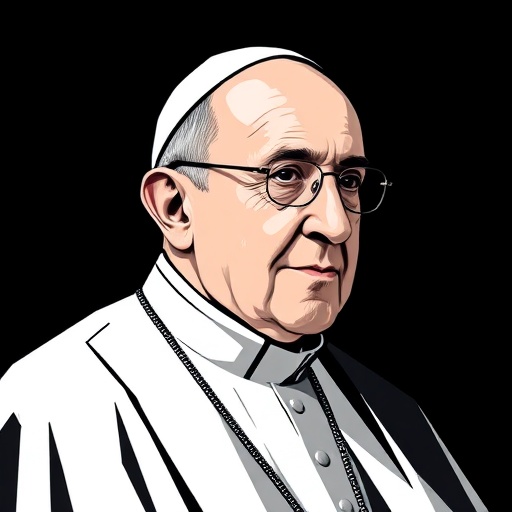
Pope Francis — "Please, do not let yourselves be robbed of hope!"
Please, do not let yourselves be robbed of hope!
Please, do not let yourselves be robbed of hope!
Click any product to generate a realistic preview. Up to 3 at a time.
* Initial load can take up to 90 seconds — revising the preview in another color is nearly instant.
"The Lord is always with us, even when we are sinners."
"The human family has not received a gift of power, but rather a stewardship, a trust that must be used with responsibility."
"The Church is not an NGO, it is not an organization that has to do things. The Church is the family of God."
"We are all sinners, but we are all loved by God."
"A good Catholic is interested in politics."
First Latin American and Jesuit pope (2013-), who has steered the Catholic Church toward pastoral inclusion on LGBTQ pastoral care, divorced Catholics, and climate. Closely associated with Pope John XXIII (the Vatican II reformer pope) and Cardinal Walter Kasper (his theological ally on pastoral reform). For an intellectual contrast, see Cardinal Raymond Burke, American traditionalist cardinal, former head of the Vatican Apostolic Signatura — Burke is the public face of Catholic traditionalism that views Francis's pastoral approach as doctrinally dangerous — he has formally challenged Amoris Laetitia and other Francis reforms.
Found in 1 providers: grok
1 source checked
A direct call to resist despair in all its modern forms—cynicism, grief, political disillusionment, or the grinding weight of poverty and injustice. By framing hope as something that can be 'robbed,' the quote positions despair as an outside aggressor, not an inevitable truth. It urges active resistance against surrender—staying engaged with life, faith, and the future even when circumstances make resignation feel rational or inevitable.
Born in Argentina and shaped by its cycles of political violence and economic collapse—including the 2001 crisis he witnessed as Archbishop of Buenos Aires—Bergoglio knows how despair spreads through communities. His pontificate opened with Evangelii Gaudium, centering joy and hope as Christianity's core message. He consistently visits prisons, slums, and refugee camps—places where hope is hardest—making this plea not rhetorical but rooted in direct pastoral experience.
Pope Francis's papacy (2013–present) spans the aftermath of the 2008 financial crisis, the European refugee emergency, the rise of authoritarian populism, COVID-19's global trauma, and accelerating climate anxiety. Declining church membership in the West and widespread mental health crises signal a cultural erosion of hope. In this environment, his repeated warnings against being 'robbed of hope' respond directly to measurable, global spiritual and social despair.
AI-generated insights based on extensive research and information for context. Factual errors? Email [email protected].
Your cart is empty