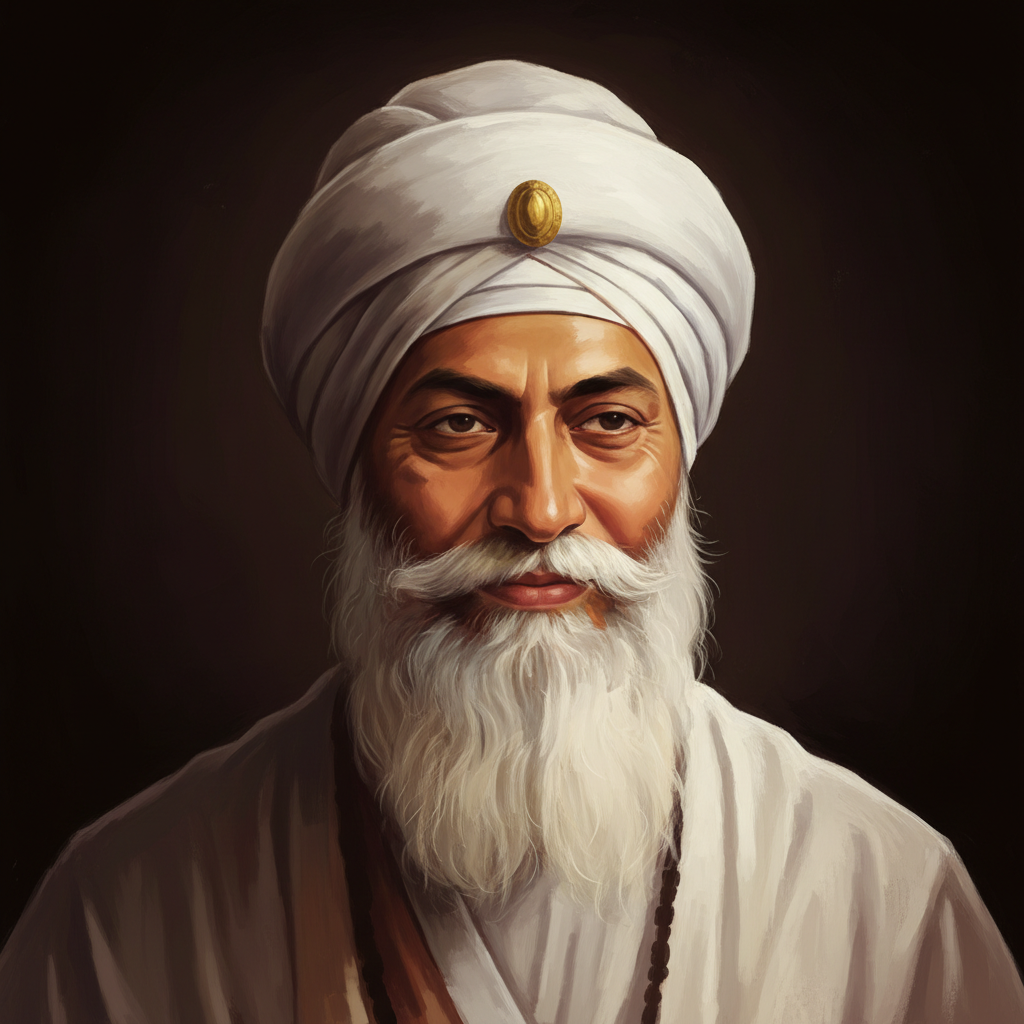
Guru Nanak — "Recognise the Lord's light within all and do not consider social class or status…"
Recognise the Lord's light within all and do not consider social class or status.
Recognise the Lord's light within all and do not consider social class or status.
Click any product to generate a realistic preview. Up to 3 at a time.
* Initial load can take up to 90 seconds — revising the preview in another color is nearly instant.
"Emotional attachment to Maya is totally painful, this is a bad bargain."
"He who considers himself humble, is the highest of all."
"Na Ham Hindu Na Musalmaan - I am not a Hindu, nor am I a Muslim."
"The Lord is neither male nor female, neither does He have any form or color."
"He who is without sin, let him cast the first stone. Or, you know, just offer a cup of chai."
Founder of Sikhism and the first of the Ten Sikh Gurus, whose teachings of one universal God and rejection of caste shaped Punjab. Closely associated with Kabir (mystical poet whose verses appear in the Sikh Guru Granth Sahib). For an intellectual contrast, see Brahmanical orthodoxy, the Hindu caste-and-ritual establishment of his era — Sikhism was founded as a deliberate alternative to both Hindu ritual hierarchy and Islamic exclusivism — Nanak's universalism was a structural rejection of caste and priestly mediation.
Found in 1 providers: gemini
1 source checked
Every person carries the divine light of God within them — caste, wealth, and social rank are spiritually irrelevant. Human worth is equal across all people regardless of birth. Treating someone as lesser because of their station directly contradicts recognizing the divine presence. True faith demands seeing God in every person you encounter: king, laborer, or outcast. Hierarchy built on class obscures the fundamental spiritual equality that connects all of humanity.
Guru Nanak (1469–1539) built Sikhism on rejecting caste hierarchy. He traveled across South Asia preaching this equality, notably sitting and eating with low-caste people — a radical act in his time. He established the langar, a communal kitchen where all ate together regardless of caste. The concept of Jot (divine light) in all beings was central to his theology. He challenged Brahmin authority directly, insisting no priest or birth status mediated the human connection to God.
Guru Nanak lived in 15th–16th century Punjab, where the Hindu caste system rigidly stratified society — Brahmins held supreme authority while Dalits faced violent exclusion from temples and public spaces. Simultaneously, the Mughal Empire was consolidating power, and Islamic social hierarchy also favored ashraf (noble-born) Muslims. Religious discrimination layered onto caste discrimination was ubiquitous. Challenging either system was dangerous. Nanak's insistence on universal divine equality was a direct political and spiritual confrontation with established power.
AI-generated insights based on extensive research and information for context. Factual errors? Email [email protected].
Your cart is empty