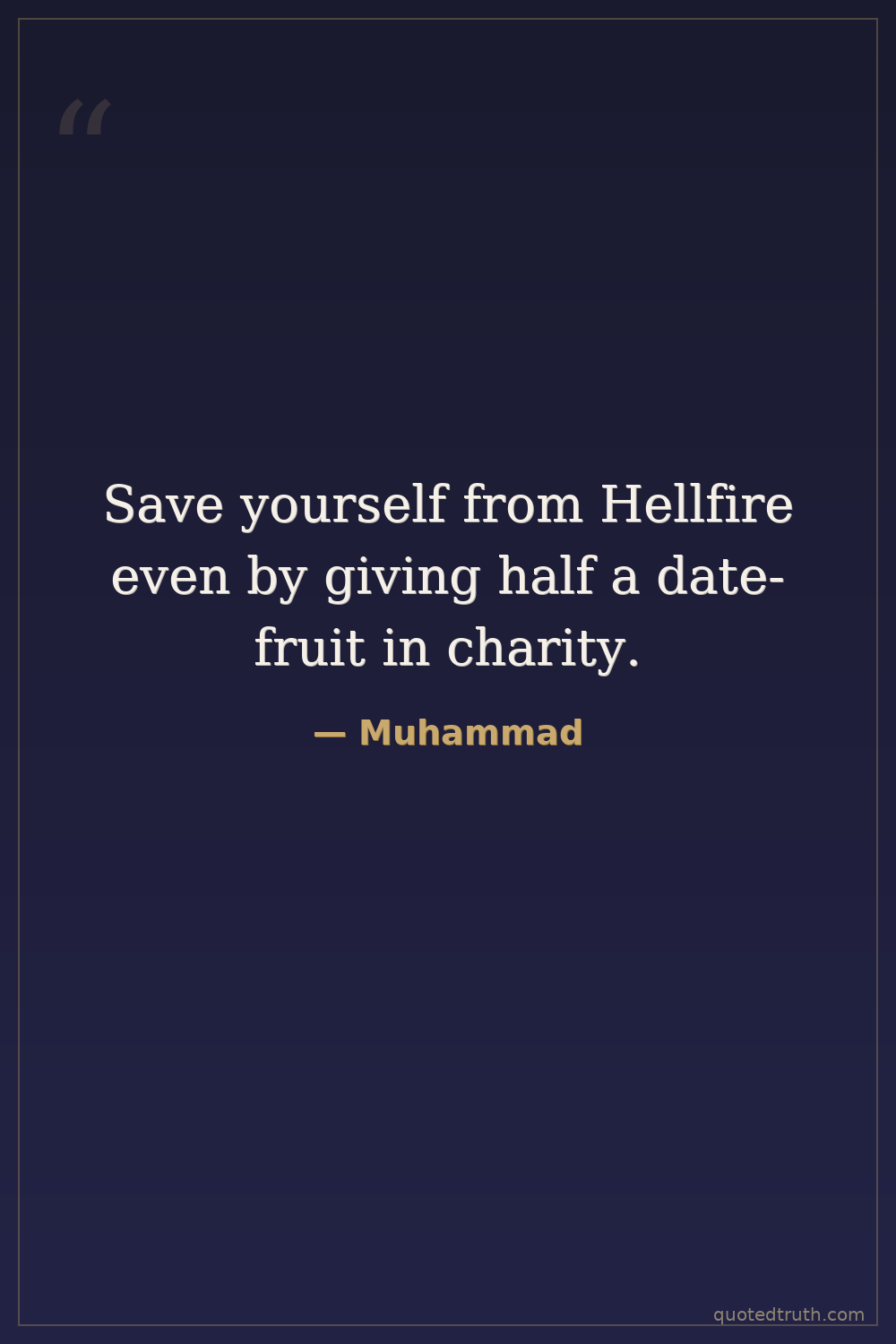
Muhammad — "Save yourself from Hellfire even by giving half a date-fruit in charity."
Save yourself from Hellfire even by giving half a date-fruit in charity.
Save yourself from Hellfire even by giving half a date-fruit in charity.
Click any product to generate a realistic preview. Up to 3 at a time.
* Initial load can take up to 90 seconds — revising the preview in another color is nearly instant.
"Heraclius' city, Constantinople, will be conquered."
"The greatest Jihad is to speak a word of truth to a tyrannical ruler."
"Beware of suspicion, for suspicion is the falsest of speech."
"The angels do not enter a house in which there is a dog or a picture."
"He who does not show mercy to others will not be shown mercy."
Found in 1 providers: gemini
1 source checked
Even the smallest act of generosity matters. You don't need wealth to do good—giving whatever little you have, even something as trivial as half a date, counts as meaningful charity. The value lies in the intention and the habit of giving, not the size of the gift. No one is too poor to be kind, and no contribution is too small to have real moral weight or spiritual consequence.
Muhammad rose from orphaned poverty to lead a community, so he understood that most followers had little to give. As a former merchant in Mecca, he knew the value of small transactions. His teachings consistently lowered barriers to piety, making charity (zakat and sadaqah) accessible to everyone regardless of means. This saying reflects his practical approach: faith demonstrated through consistent small actions rather than grand gestures reserved for the wealthy.
In 7th-century Arabia, tribal society concentrated wealth among chiefs and merchants while many lived in harsh desert poverty. Dates were a staple food and common currency for ordinary people. Charity traditionally flowed through tribal loyalty, leaving outsiders destitute. Muhammad's Medina community was building a new social structure where mutual aid crossed tribal lines. Framing charity in terms of half a date democratized giving, challenging the assumption that generosity required surplus wealth unavailable to most Arabs of the era.
AI-generated insights based on extensive research and information for context. Factual errors? Email [email protected].
Your cart is empty