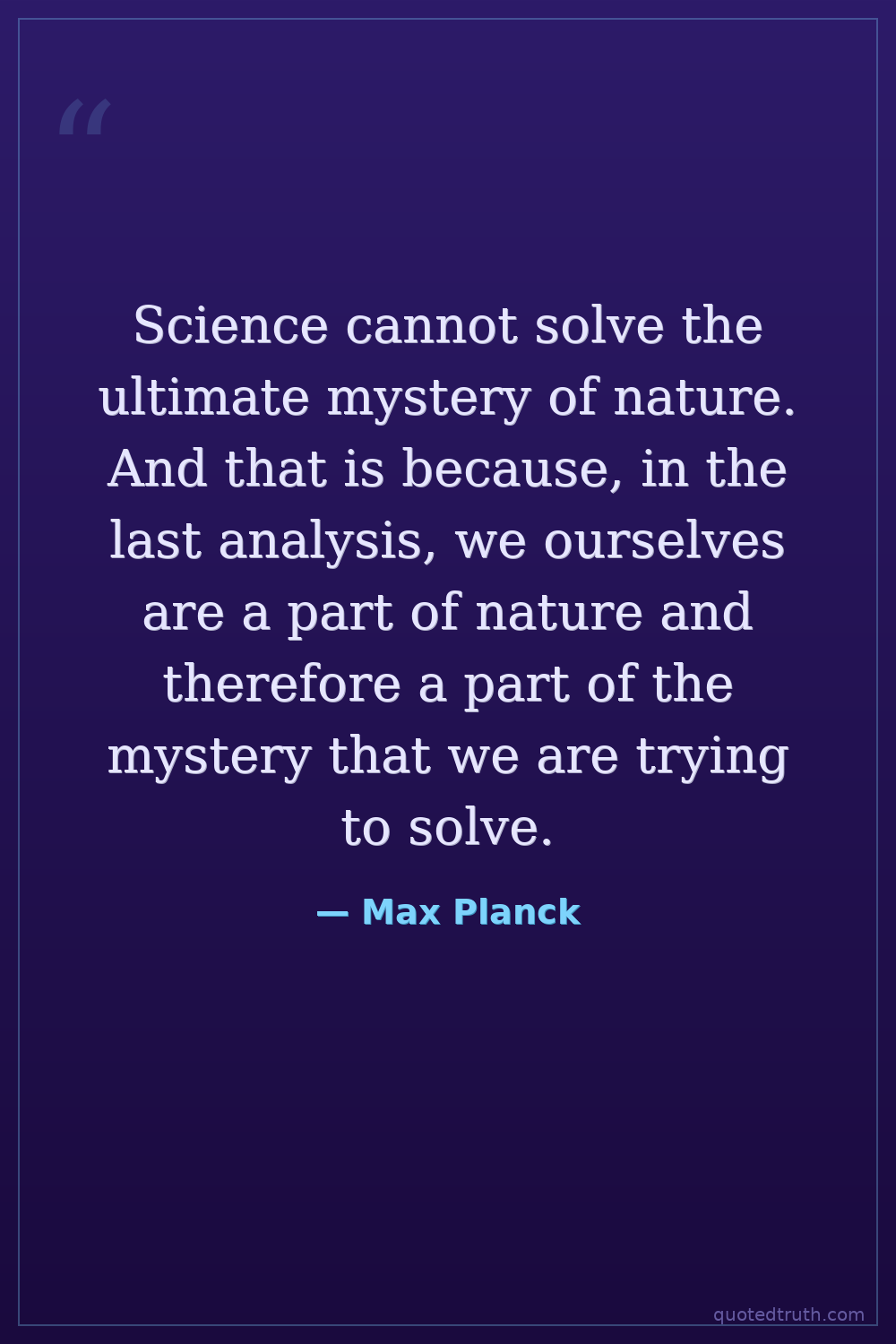
What it means
Planck argues that science has a built-in limit: we can never fully explain nature because we are not outside observers looking in. We are nature studying itself. Any investigator is made of the same stuff being investigated, so the deepest question, what reality ultimately is, includes the questioner. Science can map mechanisms endlessly, but the final why stays out of reach because the knower cannot step outside what is being known.
Relevance to Max Planck
Planck spent his career exposing the strangeness beneath physics, discovering in 1900 that energy comes in discrete quanta, which shattered classical determinism. A devout Lutheran who lost two daughters in childbirth and a son to the Nazis for plotting against Hitler, he openly held that science and a religious sense of the world were compatible. This quote reflects his mature view: the physicist who cracked the atom still insisted reality has a humbling floor that equations cannot reach.
The era
Planck lived through physics' most disorienting century. When he began, Newtonian mechanics seemed nearly complete; by the 1930s, relativity, quantum mechanics, and Heisenberg's uncertainty principle had dissolved classical certainty. Simultaneously, two world wars and Nazi rule devastated German science and his family. In that climate of collapsed absolutes, many scientists claimed materialism had answered everything, while others, like Planck, pushed back, insisting that the new physics revealed how much lay permanently beyond human grasp.
AI-generated insights based on extensive research and information for context. Factual errors? Email [email protected].