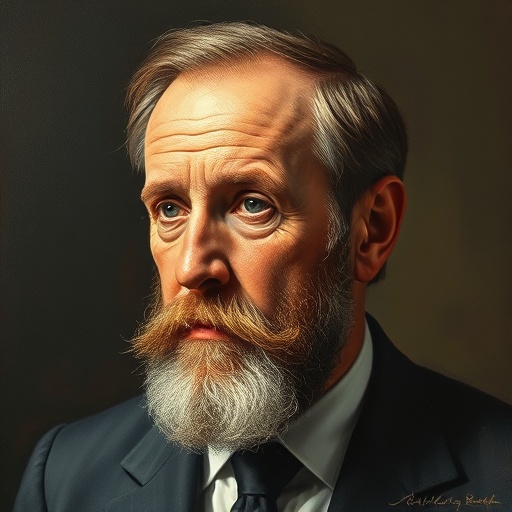
Niels Bohr — "Science is not about certainty; it is about uncertainty."
Science is not about certainty; it is about uncertainty.
Science is not about certainty; it is about uncertainty.
Click any product to generate a realistic preview. Up to 3 at a time.
* Initial load can take up to 90 seconds — revising the preview in another color is nearly instant.
"The meaning of 'real' is not a fixed one, but depends on the context."
"When we speak of the electron, we are not speaking of something that really exists, but of something that we have imagined."
"Stop telling God what to do with his dice."
"The task of science is both to extend the range of our experience and to reduce it to order."
"Truth and clarity are complementary."
Found in 1 providers: grok
1 source checked
Science advances by embracing what we don't know, not by claiming final answers. Every discovery opens new questions. Certainty is a trap that stops inquiry; uncertainty is the engine that drives it forward. Genuine scientific thinking means holding conclusions loosely, remaining open to revision, and treating doubt as productive rather than a failure of knowledge.
Bohr's Copenhagen interpretation of quantum mechanics placed uncertainty at physics' foundation. His principle of complementarity argued that contradictory descriptions can both be true depending on context. He clashed with Einstein precisely over determinism, defending the irreducible probabilistic nature of quantum reality. For Bohr, embracing uncertainty wasn't philosophical humility—it was the correct description of how atoms actually behave.
Bohr worked during quantum mechanics' revolutionary 1920s–1930s birth, when classical Newtonian certainty was collapsing. Einstein's relativity had already shaken absolute space and time. The electron's wave-particle duality, Heisenberg's uncertainty principle, and Schrödinger's equations revealed nature as fundamentally probabilistic. Scientists debated whether physics described reality or merely predicted measurements—a crisis that made uncertainty central to 20th-century scientific identity.
AI-generated insights based on extensive research and information for context. Factual errors? Email [email protected].
Your cart is empty