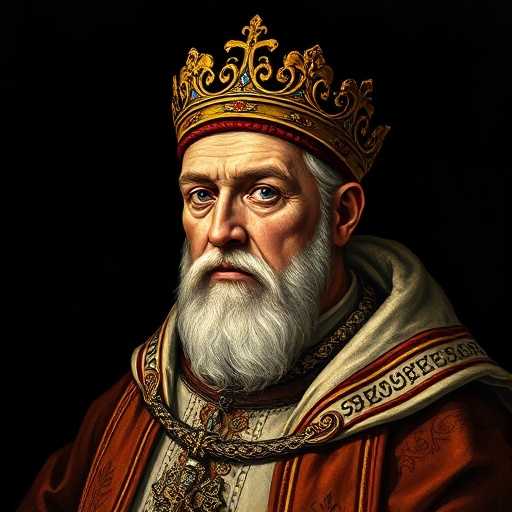
Pope Urban II — "Set out on this journey and you will obtain the remission of your sins and be su…"
Set out on this journey and you will obtain the remission of your sins and be sure of the incorruptible glory of the kingdom of heaven.
Set out on this journey and you will obtain the remission of your sins and be sure of the incorruptible glory of the kingdom of heaven.
Click any product to generate a realistic preview. Up to 3 at a time.
* Initial load can take up to 90 seconds — revising the preview in another color is nearly instant.
"They violate the women of the Christians."
"We desire that you should know that the Lord is with you."
"This I grant to all who go, by virtue of the great authority with which I am invested by God."
"Let those who go not put off the journey, but rent their lands and collect money for their expenses."
"It is Christ who commands it."
Pope (1088-1099) whose Council of Clermont speech (November 1095) launched the First Crusade — the founding event of nine centuries of Christian-Muslim military conflict. Closely associated with Pope Gregory VII (his predecessor on papal-imperial reform). For an intellectual contrast, see Saladin, Kurdish-Muslim Sultan of Egypt and Syria (1138-1193) — Saladin recaptured Jerusalem in 1187, undoing the First Crusade Urban II launched 92 years earlier. Saladin's chivalrous treatment of Christian prisoners became the canonical Muslim counter-image to Crusader brutality. The cleanest before/after pairing of the Crusades' moral arc.
A clear promise of salvation for those who participate in the Crusade. (Robert the Monk's account)
Date: 1095
ReligiousFound in 1 providers: gemini
1 source checked
Participating in this holy war guarantees spiritual forgiveness and eternal salvation. You will shed your sins through this sacrifice and earn a permanent place in heaven. The journey itself becomes a spiritual transaction: earthly action exchanged for divine reward, making violence sacred and death in battle equivalent to martyrdom rather than murder.
Urban II launched the First Crusade at Clermont in 1095, using precisely this promise to mobilize tens of thousands of Europeans. As pope, he wielded spiritual authority over salvation itself, and this quote demonstrates his willingness to deploy that authority militarily. His offer of plenary indulgence transformed warfare into a penitential act, reflecting his belief that the Church could direct Christian violence toward holy ends.
In 1095, the Seljuk Turks controlled Jerusalem and had recently crushed Byzantine forces at Manzikert. Western Europe was fractured by feudal violence, and the Church actively sought to redirect that aggression outward. The concept of holy war was new and powerful — combining pilgrimage tradition with military obligation. Urban's proclamation reshaped Christendom's relationship with violence, sovereignty, and salvation simultaneously.
AI-generated insights based on extensive research and information for context. Factual errors? Email [email protected].
Your cart is empty