What it means
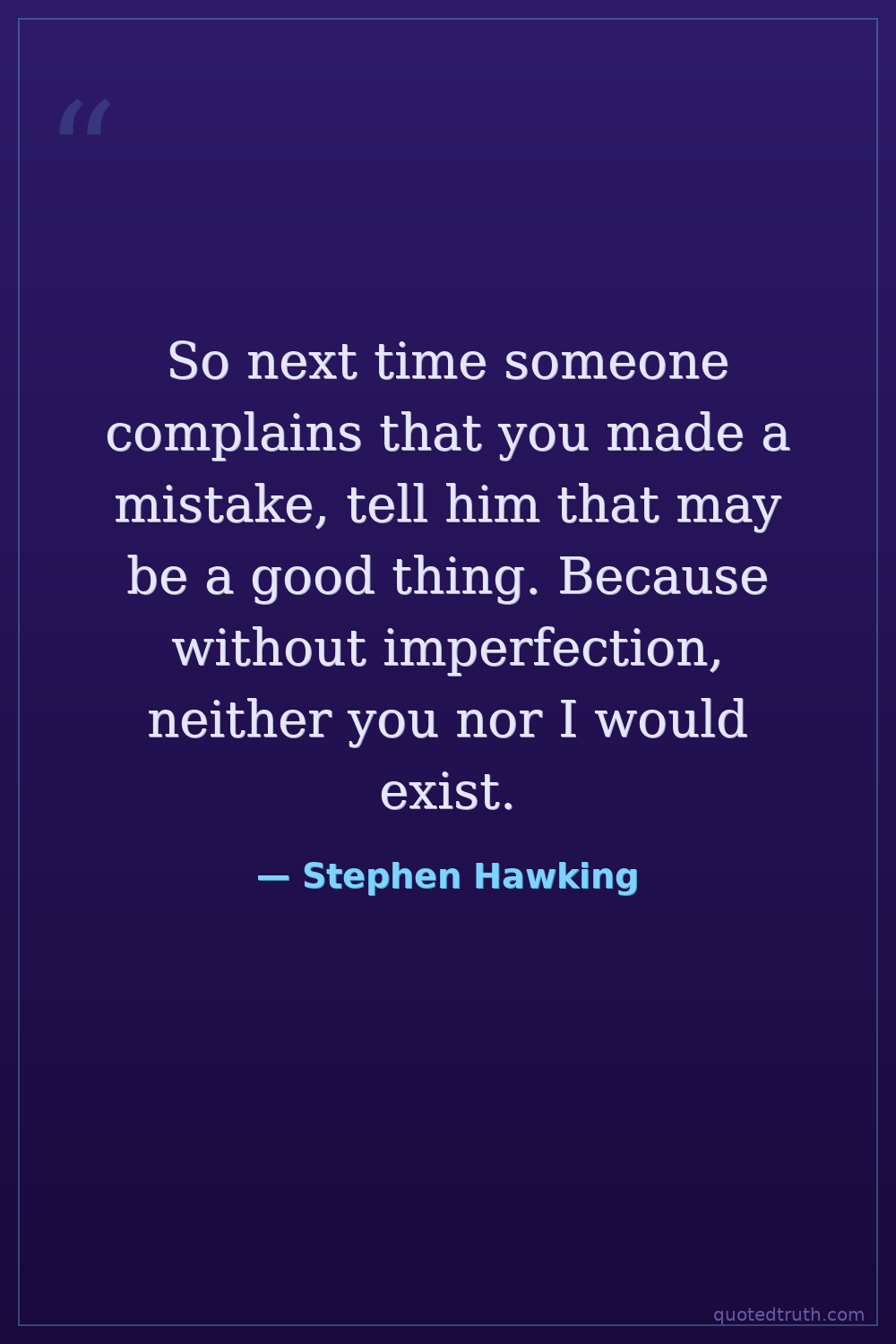
Imperfection and error are not flaws to eliminate but essential conditions for existence itself. Mistakes drive variation, adaptation, and complexity. Without asymmetry and deviation from the ideal, the universe would be perfectly uniform and lifeless. Embracing imperfection means recognizing that the messy, irregular, imprecise nature of reality is precisely what generates everything meaningful, including consciousness, life, and human connection.
Relevance to Stephen Hawking
Hawking's entire career centered on cosmological asymmetry — the slight matter-antimatter imbalance after the Big Bang that allowed the universe to exist rather than annihilate. He also lived with ALS for over fifty years, turning profound physical limitation into groundbreaking scientific output. His survival and productivity were themselves arguments that imperfection generates rather than destroys meaning.
The era
Hawking spoke during an era of genetic engineering breakthroughs, computing perfectionism, and growing pressure for human optimization. The 1980s–2000s saw debates about designer babies, AI precision, and corporate zero-defect culture. His cosmological perspective offered a counterweight: the Big Bang's own slight irregularities seeded galaxies, stars, and life, making imperfection the universe's most fundamental creative force.
AI-generated insights based on extensive research and information for context. Factual errors? Email [email protected].