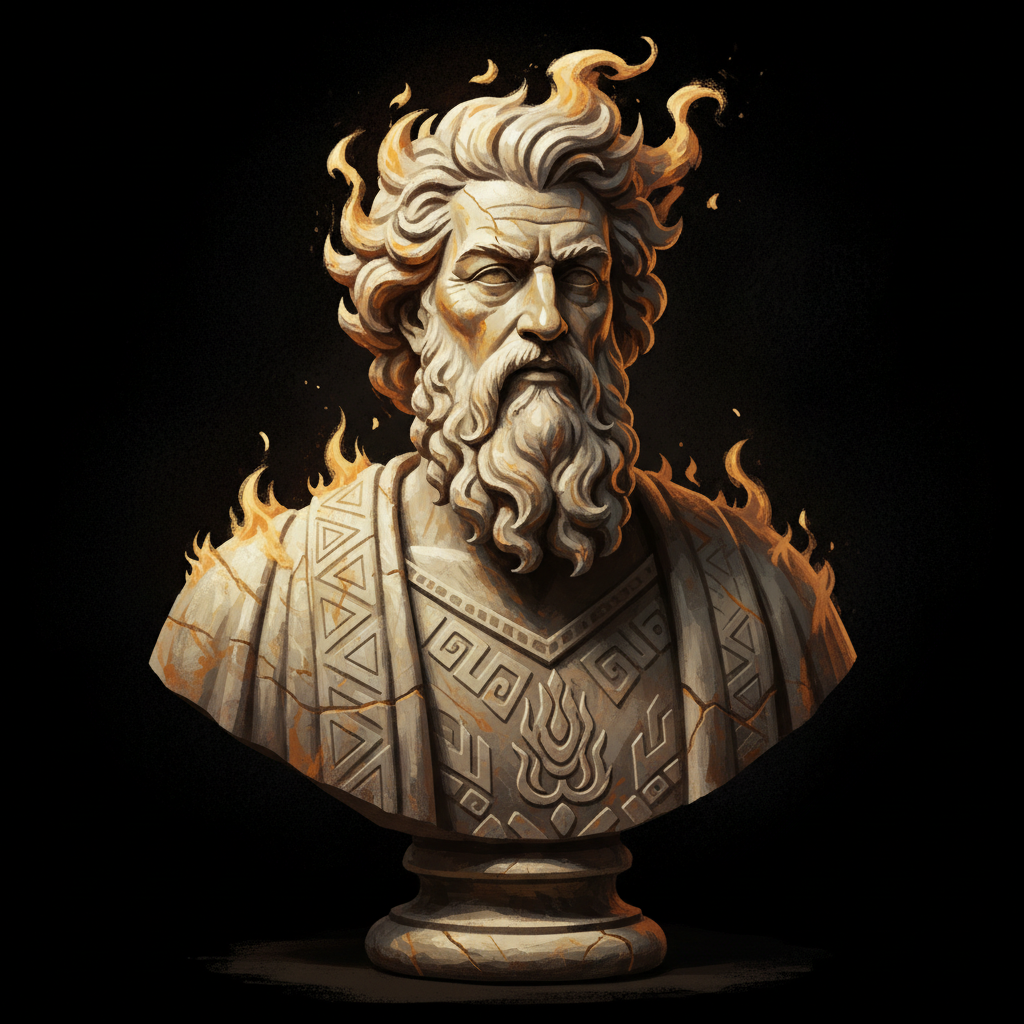
Zoroaster — "Taking the first footstep with a good thought, the second with a good word, and …"
Taking the first footstep with a good thought, the second with a good word, and the third with a good deed. I entered paradise.
Taking the first footstep with a good thought, the second with a good word, and the third with a good deed. I entered paradise.
Click any product to generate a realistic preview. Up to 3 at a time.
* Initial load can take up to 90 seconds — revising the preview in another color is nearly instant.
"The Ox-soul lamented to you: 'For whom did you shape me? Who created me? Fury and violence oppress me, and cruelty and bondage.'"
"The greatest battle is within oneself. And sometimes, that battle is with the urge to hit the snooze button."
"For the wise, the truth is clear; for the foolish, it is hidden."
"He who seeks wisdom, him Ahura Mazda will enlighten."
"Hear with your ears the best things; behold with a clear vision the two choices, deciding each man for himself, before the great consummation."
Iranian prophet who founded Zoroastrianism, the first major religion of cosmic dualism between good (Ahura Mazda) and evil (Angra Mainyu). Closely associated with The Buddha (near-contemporary Eastern moral-cosmological revolutionary). For an intellectual contrast, see Friedrich Nietzsche, German philosopher of 'beyond good and evil' — Nietzsche appropriated Zarathustra's name for Thus Spoke Zarathustra (1883) precisely to invert the original's moral cosmology — the historical Zoroaster founded the good-versus-evil framework Nietzsche's character announces the end of.
Found in 1 providers: gemini
1 source checked
Reaching a state of inner peace or spiritual fulfillment requires alignment across three levels of being: what you think, what you say, and what you do. Each step builds on the last. A good intention alone is not enough; it must be voiced honestly and then acted upon. When thought, speech, and action move in the same direction toward goodness, you arrive at something resembling paradise, not as a place but as a way of living.
This is the cornerstone of Zoroaster's entire ethical system, known as Humata, Hukhta, Hvarshta, the triad of Good Thoughts, Good Words, Good Deeds. As a prophet and reformer of ancient Iranian religion, he rejected ritual sacrifice in favor of personal moral choice. He taught that every individual has free will to choose between Asha, truth and order, and Druj, the lie. This saying compresses his lifelong message into a single walking metaphor.
Zoroaster lived in ancient Persia, likely between 1500 and 1000 BCE, during the Bronze Age transition of Indo-Iranian tribal society. Religion at the time centered on polytheism, animal sacrifice, and priestly ritual controlled by elite castes. His message was radical: individual ethical conduct mattered more than ceremony, and ordinary people, not just priests, shaped their afterlife through choices. This monotheistic, ethics-first framework later influenced Judaism, Christianity, and Islam.
AI-generated insights based on extensive research and information for context. Factual errors? Email [email protected].
Your cart is empty