What it means
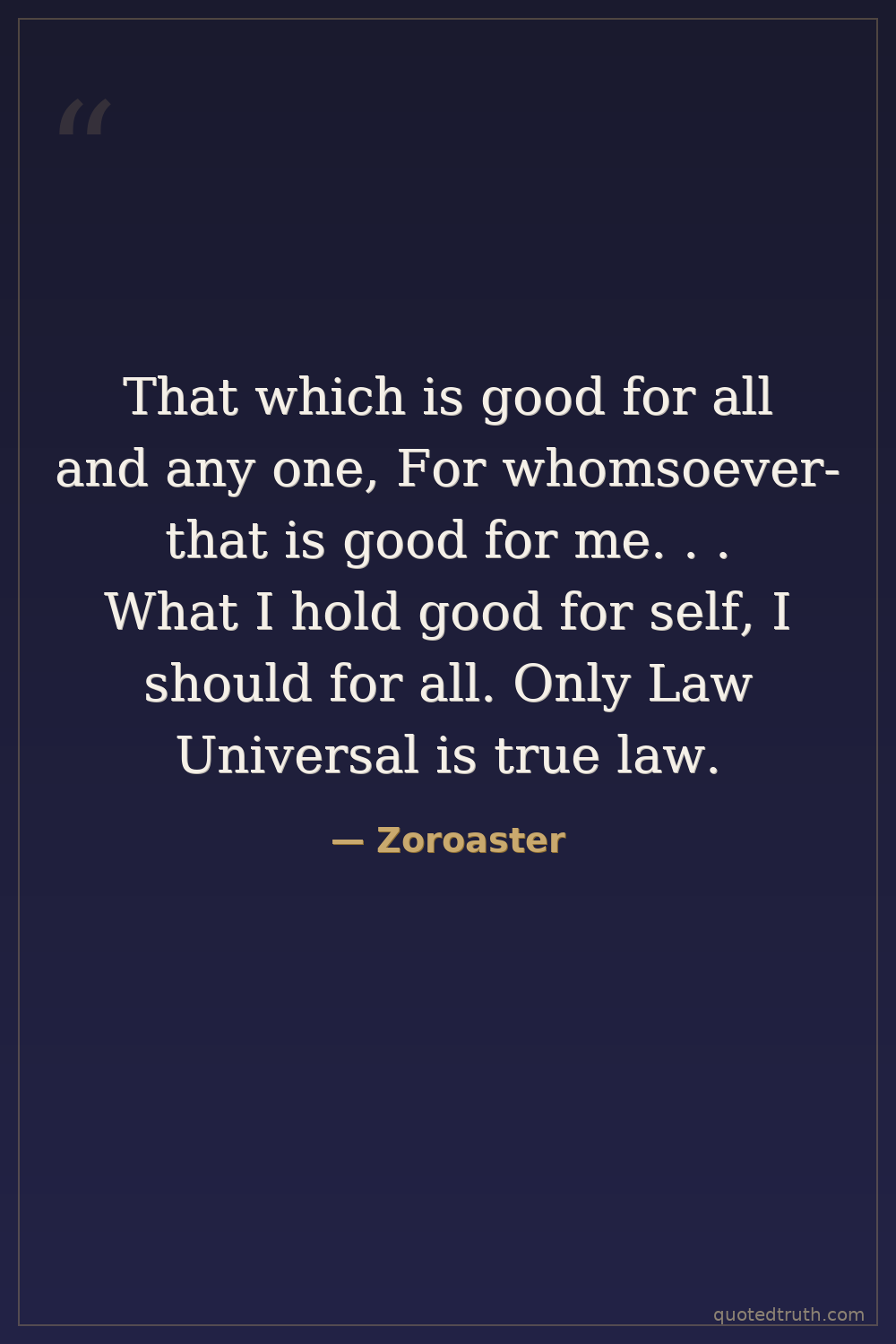
Genuine goodness cannot be selfish or tribal. If something truly benefits one person, it must be capable of benefiting everyone; otherwise it is just private advantage dressed up as virtue. The standard you apply to yourself is the same standard you owe others. Only principles that hold up universally, applying equally to all people without exception, qualify as real moral law. Anything narrower is bias, not ethics.
Relevance to Zoroaster
Zoroaster founded one of the earliest monotheistic faiths and preached asha, the cosmic order of truth and righteousness, against druj, the lie. As a reforming priest who broke with tribal polytheism, he insisted morality was a free choice binding every human equally, not a privilege of clan or caste. This quote mirrors his signature teaching of Good Thoughts, Good Words, Good Deeds as a universal standard available to all.
The era
Zoroaster lived in Bronze Age Iran, likely between 1500 and 1000 BCE, among semi-nomadic Indo-Iranian tribes whose religion centered on ritual sacrifice, warrior gods, and ethics bounded by kinship. Raiding neighbors was honorable; outsiders had no moral claim. By proclaiming a single ethical law applying to all people regardless of tribe, he anticipated the universalist ethics later central to Judaism, Greek philosophy, and the Golden Rule across world religions.
AI-generated insights based on extensive research and information for context. Factual errors? Email [email protected].