What it means
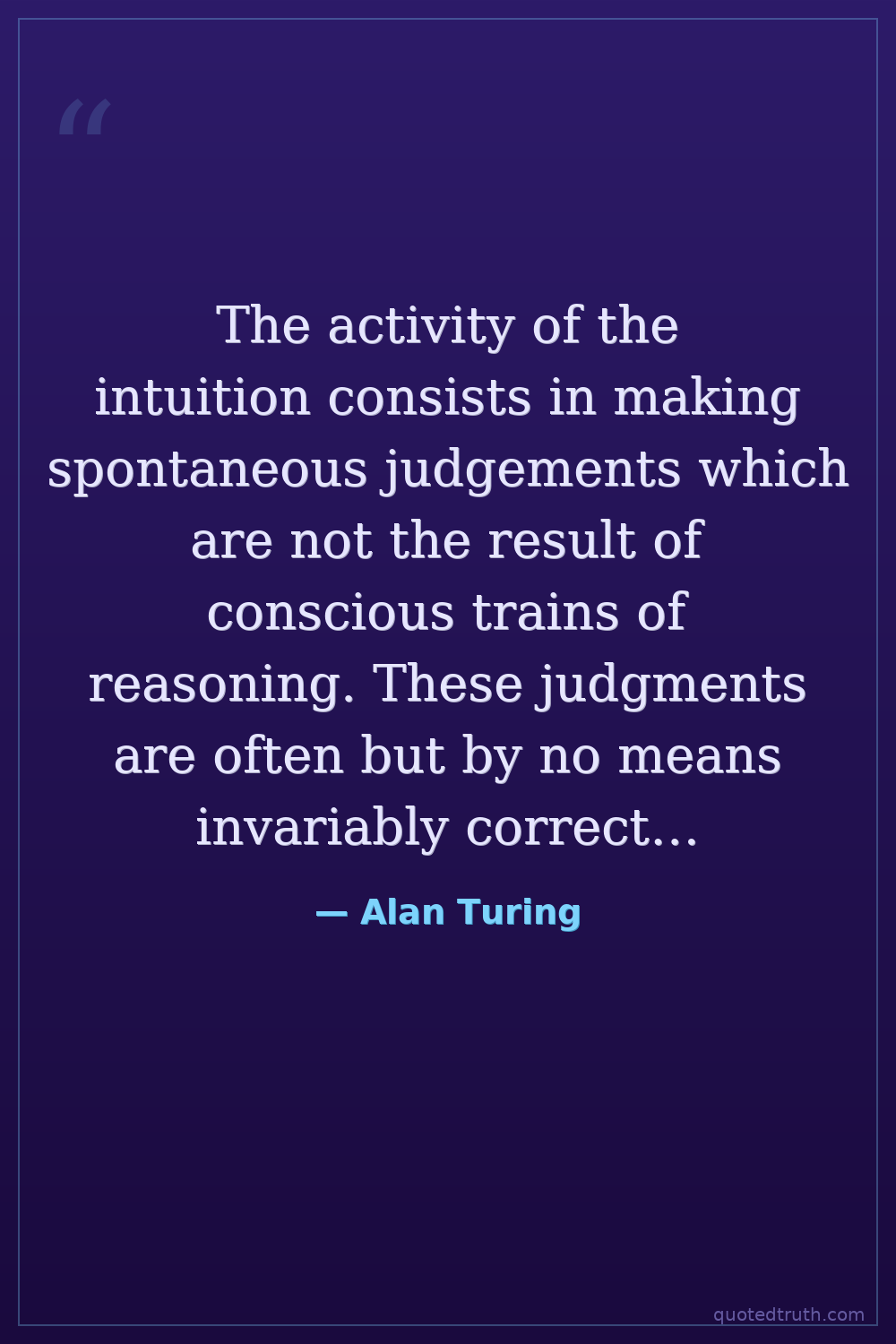
Intuition produces snap judgments that bypass conscious, step-by-step reasoning. These gut-level conclusions can be right, but they aren't guaranteed to be — accuracy varies. Turing draws a careful empirical line: intuition is a real and valuable cognitive tool, not mere noise, yet it demands scrutiny rather than blind trust. The honest admission of fallibility distinguishes this from romanticizing intuition; it's a pragmatic acknowledgment of how the mind actually operates without formal reasoning.
Relevance to Alan Turing
Turing wrote this in 'Computing Machinery and Intelligence' (1950) while exploring whether machines could think. At Bletchley Park, he cracked Enigma through both rigorous mechanical logic — the Bombe — and intuitive leaps about German operators' habits. As a mathematician, he knew conjectures often precede proofs: intuition points the way, proof confirms it. His lifelong project of formalizing thought made understanding intuition's powers and limits a central professional and philosophical concern.
The era
Written in 1950, as the first stored-program computers emerged and critics argued machines could never truly think because they lacked intuition — a supposedly irreducible human quality. The era also saw the rise of cybernetics and early cognitive science, which attempted to model the mind mechanistically. By defining intuition precisely and noting its fallibility, Turing reframed it as potentially understandable and perhaps replicable, rather than a mystical barrier separating human minds from machines.
AI-generated insights based on extensive research and information for context. Factual errors? Email [email protected].