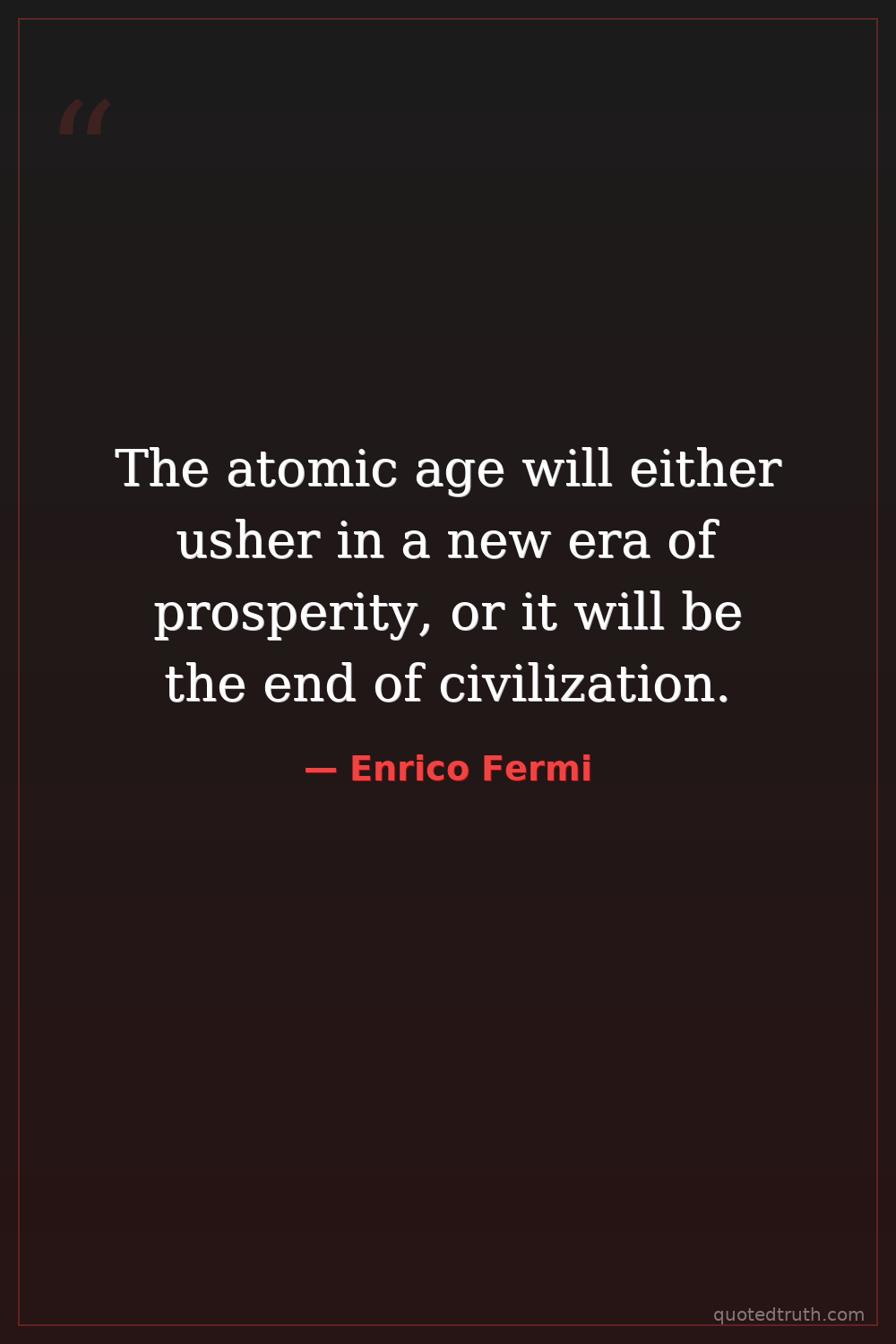
Enrico Fermi — "The atomic age will either usher in a new era of prosperity, or it will be the e…"
The atomic age will either usher in a new era of prosperity, or it will be the end of civilization.
The atomic age will either usher in a new era of prosperity, or it will be the end of civilization.
Click any product to generate a realistic preview. Up to 3 at a time.
* Initial load can take up to 90 seconds — revising the preview in another color is nearly instant.
"It is not enough to know how to build a bomb. One must also know how to control it."
"Physics is like sex: sure, it may give some practical results, but that's not why we do it."
"The problem of making a nuclear reactor is not a problem of physics, but a problem of engineering."
"I am grateful for the opportunity to have contributed to the advancement of science, and to have witnessed the birth of the atomic age."
"I remember my first impression of the Trinity test. It was a terrifying spectacle."
Found in 1 providers: grok
1 source checked
Nuclear technology represents humanity's most consequential fork in the road. It can power cities, fuel medicine, and lift billions from poverty—or, weaponized at scale, end civilization through war. There is no middle ground: the same physics that lights a reactor can vaporize a city. The quote captures a stark either/or reality—nuclear power demands collective wisdom because the downside is total, irreversible destruction with no second chance.
Fermi built the world's first artificial nuclear reactor beneath the University of Chicago's Stagg Field in 1942, making this prosperity-or-extinction tension deeply personal. He worked at Los Alamos on the bomb he knew could annihilate cities. A Nobel laureate who fled Fascist Italy, he understood both science's transformative power and political catastrophe. His death in 1954—likely from radiation-related stomach cancer—underscored that even the pioneers bore the atomic age's hidden costs.
Fermi spoke in the shadow of Hiroshima and Nagasaki (1945) and an accelerating Cold War arms race. The Soviet Union tested its first nuclear weapon in 1949; hydrogen bomb development quickly followed. Simultaneously, nuclear energy promised cheap abundant electricity. The world faced genuine existential uncertainty: would atoms liberate or annihilate? The UN Atomic Energy Commission formed, civilian nuclear programs launched, and civil defense drills became routine—all while world-ending stockpiles continued growing.
AI-generated insights based on extensive research and information for context. Factual errors? Email [email protected].
Your cart is empty