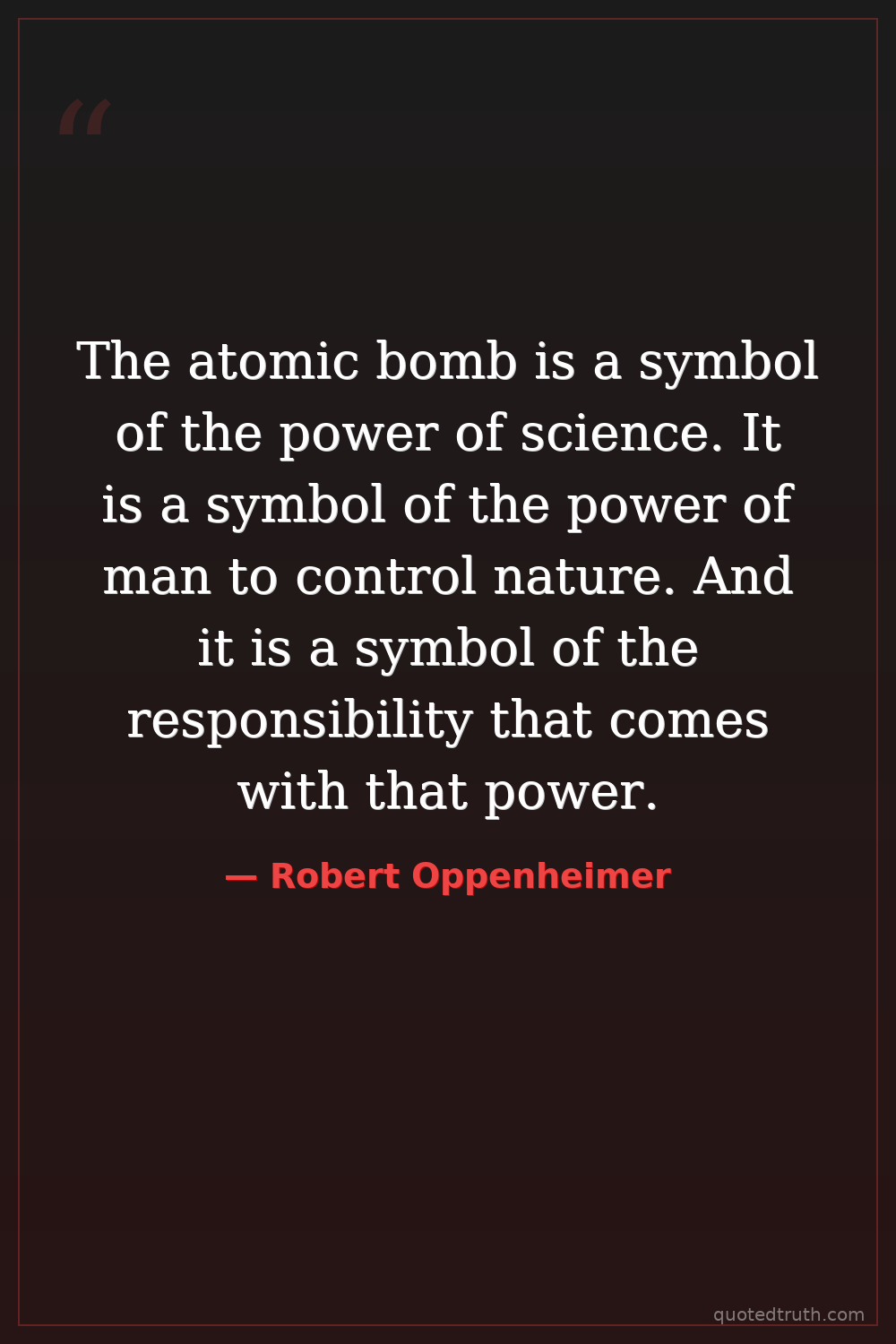
What it means
Science unlocks immense natural forces, but wielding them carries profound moral weight. The bomb represents humanity's peak technological achievement — reshaping warfare, geopolitics, and civilization itself — while demanding that those who create such tools accept responsibility for their consequences. Power and accountability are inseparable. Those who can build world-altering weapons must answer for how, when, and whether they are used.
Relevance to Robert Oppenheimer
Oppenheimer directed the Los Alamos laboratory that built the first nuclear weapons, witnessing the Trinity test on July 16, 1945. After the bombings of Hiroshima and Nagasaki killed over 200,000 people, he famously quoted the Bhagavad Gita: 'I am become Death.' He later opposed the hydrogen bomb and advocated for international arms control, believing scientists bore direct moral responsibility for their inventions — a conviction that cost him his security clearance in 1954.
The era
The mid-20th century saw unprecedented scientific power unleashed. After Hiroshima and Nagasaki in 1945, the Cold War nuclear arms race accelerated — the USSR tested its bomb in 1949, triggering the hydrogen bomb program and the doctrine of Mutually Assured Destruction. Scientists worldwide grappled with their complicity in mass destruction, producing the Bulletin of Atomic Scientists, the Doomsday Clock, and foundational public debates about whether scientific capability should constrain scientific responsibility.
AI-generated insights based on extensive research and information for context. Factual errors? Email [email protected].