Galileo Galilei — "The authority of a thousand is not worth the humble reasoning of a single indivi…"
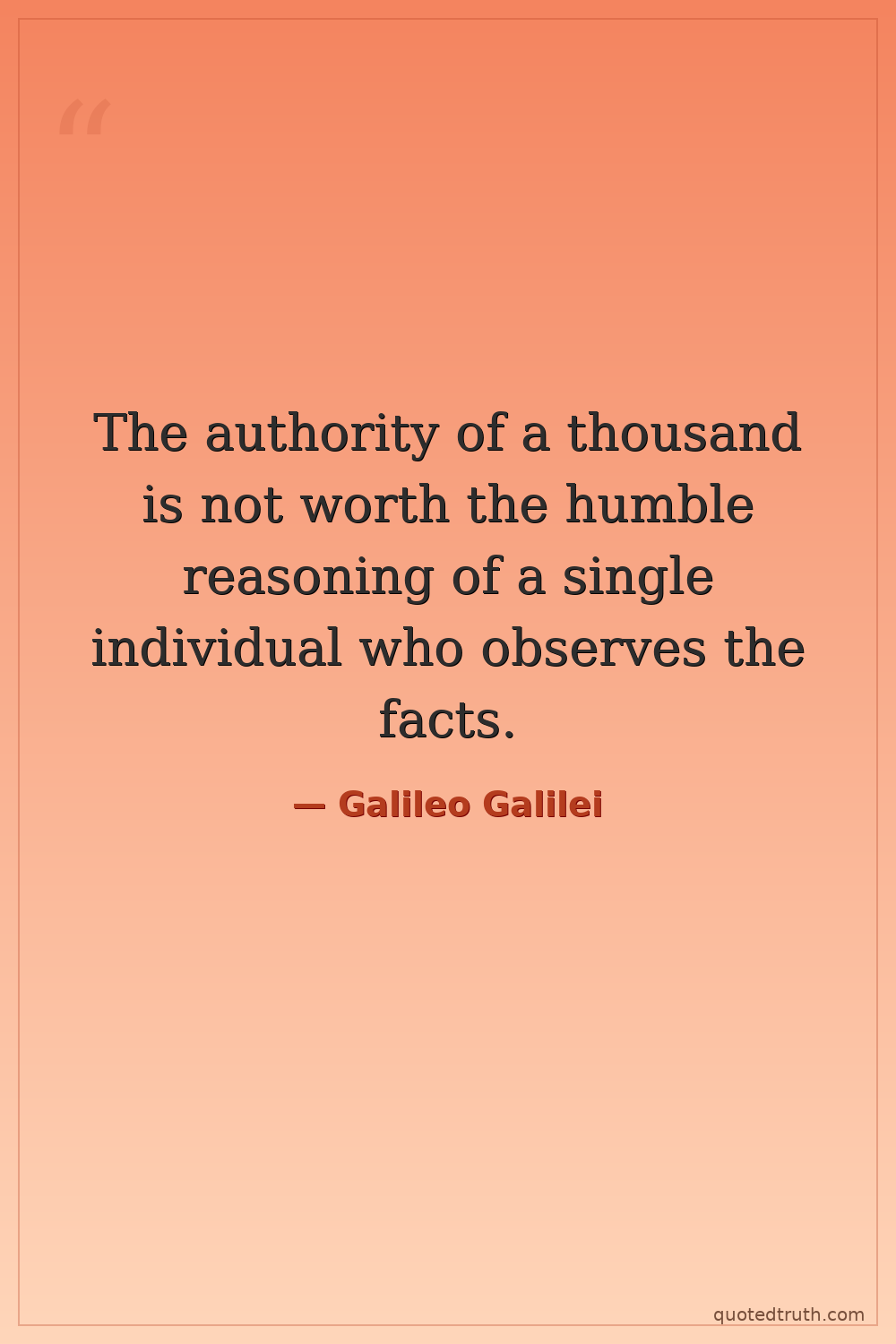
The authority of a thousand is not worth the humble reasoning of a single individual who observes the facts.
The authority of a thousand is not worth the humble reasoning of a single individual who observes the facts.
Click any product to generate a realistic preview. Up to 3 at a time.
* Initial load can take up to 90 seconds — revising the preview in another color is nearly instant.
"It is not in the power of any created being to make things true or false, but only to make us think them so."
"To command the sun and moon, God must have given them motion."
"I hold the sun to be situated motionless in the center of the revolution of the celestial orbs while the earth revolves around the sun."
"In questions of science, the authority of a thousand is not worth the humble reasoning of a single individual."
"I do not believe that the same God who has given us senses, reason and intellect would have us abandon their use."
Found in 1 providers: grok
1 source checked
Raw numbers of believers or experts cannot override careful, evidence-based thinking by one honest person. Truth is determined by direct observation and logical reasoning, not by how many authority figures agree on something. A single thinker who actually examines the facts outweighs any crowd of people who simply repeat received wisdom without questioning it.
Galileo spent his career fighting the Catholic Church and Aristotelian scholars who used institutional authority rather than evidence to defend geocentrism. He built telescopes, observed Jupiter's moons and Venus's phases, and published findings that contradicted centuries of consensus. His 1633 Inquisition trial proved this conviction cost him dearly — he lived under house arrest for refusing to abandon observed fact.
In early modern Europe, scholastic tradition treated Aristotle and Church doctrine as unquestionable authorities. The Scientific Revolution was dismantling this by insisting nature itself, not ancient texts, settles disputes. Galileo's era saw fierce conflict between empirical observation and institutional orthodoxy, making the question of whose reasoning counts — the individual observer or the established hierarchy — genuinely dangerous to answer honestly.
AI-generated insights based on extensive research and information for context. Factual errors? Email [email protected].
Your cart is empty