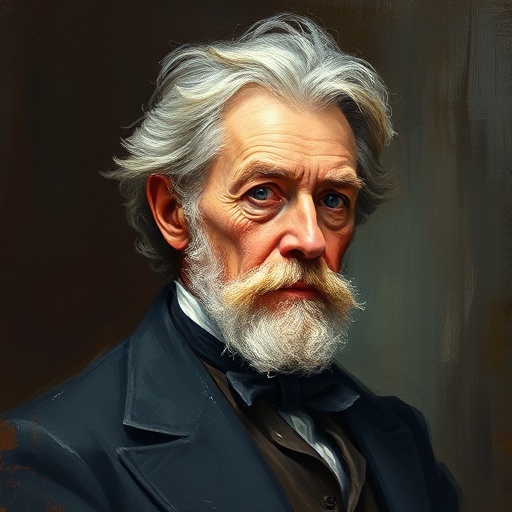
Michael Faraday — "The beauty of nature is a constant source of inspiration for me."
The beauty of nature is a constant source of inspiration for me.
The beauty of nature is a constant source of inspiration for me.
Click any product to generate a realistic preview. Up to 3 at a time.
* Initial load can take up to 90 seconds — revising the preview in another color is nearly instant.
"I shall be as patient as I can."
"I have been working for some time on the subject of electricity and magnetism, and I think I have made some discoveries."
"I have far more confidence in the one man who works mentally and bodily at a matter than in the six who merely talk about it."
"I have always tried to make my lectures as clear and simple as possible, so that they may be understood by all."
"The history of science is his library."
Attributed, reflecting his aesthetic appreciation for the natural world.
Date: Mid 19th Century (approx.)
Art & CreativityFound in 1 providers: grok
1 source checked
Faraday is saying that the natural world keeps fueling his curiosity and creativity. Watching how things behave in nature, from magnets to light to living organisms, continually gives him fresh ideas and motivation to keep working. Rather than treating science as dry problem-solving, he frames it as an aesthetic experience, where wonder at the physical world is what drives discovery and sustains his energy over a long career.
Faraday rose from bookbinder's apprentice to discoverer of electromagnetic induction through observation and hands-on experiment rather than advanced mathematics. A devout Sandemanian Christian, he viewed nature as a divine creation worth studying reverently. His famous Royal Institution Christmas Lectures, especially The Chemical History of a Candle, show exactly this stance: treating a candle flame or a magnetic field as beautiful objects whose careful study reveals deep truths about how the world works.
Faraday lived 1791-1867, during Britain's Industrial Revolution and the Romantic era's fascination with nature. Steam engines, railways, and factories were transforming society, while poets like Wordsworth and painters like Turner celebrated natural beauty against that mechanical backdrop. Science was shifting from gentlemen's hobby to professional discipline, with the Royal Institution popularizing research for public audiences. Faraday's reverence for nature's beauty fit this cultural moment, bridging Romantic wonder and rigorous experimental method before Darwin and Maxwell reshaped the field.
AI-generated insights based on extensive research and information for context. Factual errors? Email [email protected].
Your cart is empty