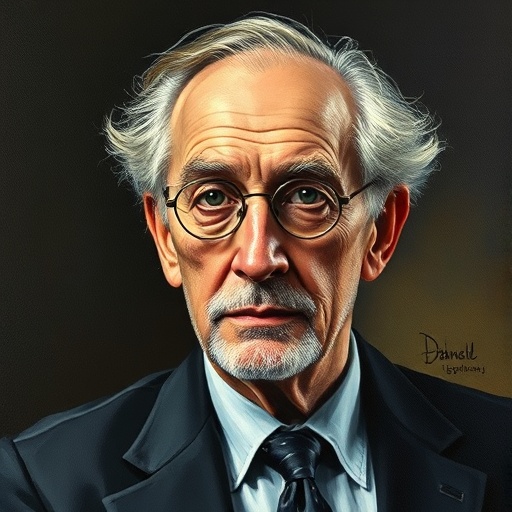
Francis Crick — "The belief that we have immortal souls is a superstition."
The belief that we have immortal souls is a superstition.
The belief that we have immortal souls is a superstition.
Click any product to generate a realistic preview. Up to 3 at a time.
* Initial load can take up to 90 seconds — revising the preview in another color is nearly instant.
"The more I learn about science, the more I realize that there is no God."
"It is notoriously difficult to get rid of a really bad idea."
"We were searching for a structure so simple and beautiful that it had to be true."
"The brain is a machine that makes theories."
"The genetic code is a frozen accident."
In his book 'The Astonishing Hypothesis: The Scientific Search for the Soul'
Date: 1994
ReligiousFound in 1 providers: deepseek
1 source checked
Religious and cultural traditions hold that each person possesses an immortal soul — an immaterial essence that survives death and defines who we truly are. Crick flatly rejects this, placing it in the same category as folklore and myth: a belief sustained by habit and tradition, not evidence. Everything we call the self — thought, memory, personality — arises from physical brain activity and ceases entirely when the body dies.
Crick co-discovered DNA's double helix in 1953, proving life's deepest instructions are encoded in chemistry. He later turned to consciousness, arguing in 'The Astonishing Hypothesis' (1994) that the soul is simply the brain's neural activity — nothing more. A lifelong atheist and committed materialist, his entire career rested on the premise that heredity, perception, and identity all yield to physical explanation, making this quote a direct extension of his scientific worldview.
Crick worked through the mid-20th century into the 2000s, when molecular biology and neuroscience were systematically dismantling supernatural explanations for life. The 1953 DNA discovery accelerated scientific materialism. By the 1990s, the 'decade of the brain' produced fMRI scanning and detailed neural maps of memory and emotion. Simultaneously, New Atheism was rising, with scientists publicly challenging religion's authority over questions of consciousness, identity, and what it means to be human.
AI-generated insights based on extensive research and information for context. Factual errors? Email [email protected].
Your cart is empty