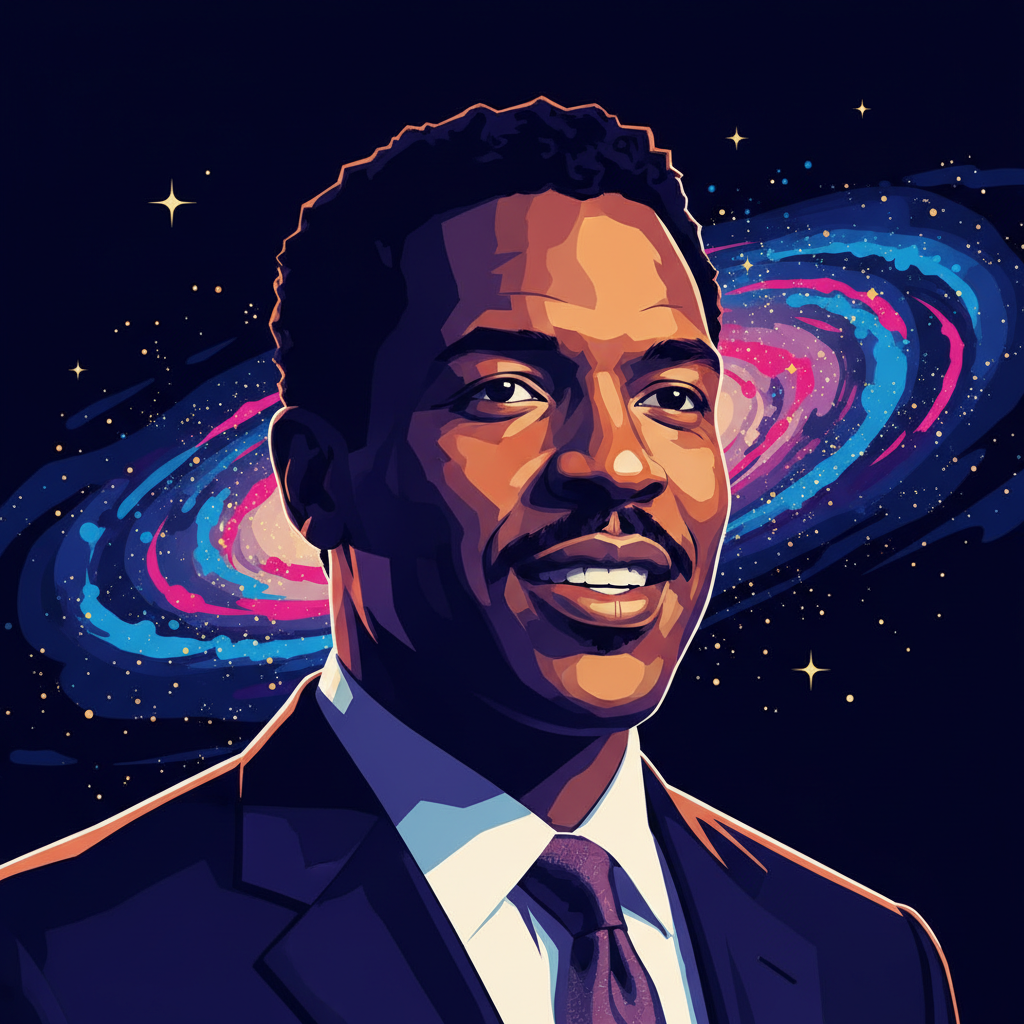
Neil deGrasse Tyson — "The best thing about being a scientist is that you get to ask 'why?' all the tim…"
The best thing about being a scientist is that you get to ask 'why?' all the time.
The best thing about being a scientist is that you get to ask 'why?' all the time.
Click any product to generate a realistic preview. Up to 3 at a time.
* Initial load can take up to 90 seconds — revising the preview in another color is nearly instant.
"The universe is not fair. It just is."
"For me, I am a cosmic optimist. I always think that we will find solutions to our problems."
"The universe is an amazing place, and it's full of surprises."
"I'm not saying I'm a genius. I'm just saying I have a lot of questions."
"I'm not trying to be the smartest guy in the room. I'm just trying to be the guy who asks the right questions."
American astrophysicist, Hayden Planetarium director, and Cosmos: A Spacetime Odyssey host who carries the Carl Sagan public-science mantle. Closely associated with Bill Nye (fellow science communicator) and Brian Greene (theoretical physicist and string-theory popularizer). For an intellectual contrast, see Ken Ham, founder of Answers in Genesis and the Creation Museum — Ham's career has been organized around defending biblical 6-day creationism — exactly the science-education position Tyson's mainstream-science communication is structured to refute.
Found in 1 providers: grok
1 source checked
Science grants perpetual permission to question everything. Unlike most professions where questioning too much can be seen as disruptive or naive, scientists are professionally obligated to interrogate assumptions, demand evidence, and remain unsatisfied with incomplete explanations. Curiosity isn't just tolerated—it's the core job requirement. This celebrates intellectual restlessness as a virtue rather than an annoyance.
Tyson built his career not just as a researcher but as a public communicator who famously rekindles childhood wonder in adult audiences. His StarTalk podcast, Cosmos series, and countless interviews center on enthusiastic questioning. He consistently frames science as accessible joy rather than elite gatekeeping, embodying the childlike 'why' as professional identity across decades of public engagement.
In an era of partisan anti-intellectualism, science denialism around climate change and vaccines, and declining STEM enrollment concerns, Tyson emerged as science's most visible defender. His statement pushes back against cultures that discourage questioning authority or established belief. Post-2000s social media amplified both science skepticism and science enthusiasm, making his advocacy for curiosity culturally urgent.
AI-generated insights based on extensive research and information for context. Factual errors? Email [email protected].
Your cart is empty