William Harvey — "The blood flows from the right ventricle through the lungs to the left auricle."
The blood flows from the right ventricle through the lungs to the left auricle.
The blood flows from the right ventricle through the lungs to the left auricle.
Click any product to generate a realistic preview. Up to 3 at a time.
* Initial load can take up to 90 seconds — revising the preview in another color is nearly instant.
"It is a thing worthy of observation how much more easily and quickly the mind is deceived than the eye."
"The blood, in truth, is the fountain of life, the first to move and the last to rest."
"Nature is nowhere accustomed to exhibit herself more openly than in her failures."
"The world is full of wonders, but man is the greatest wonder of all."
"The vital spirit is not a separate entity, but intimately connected with the blood."
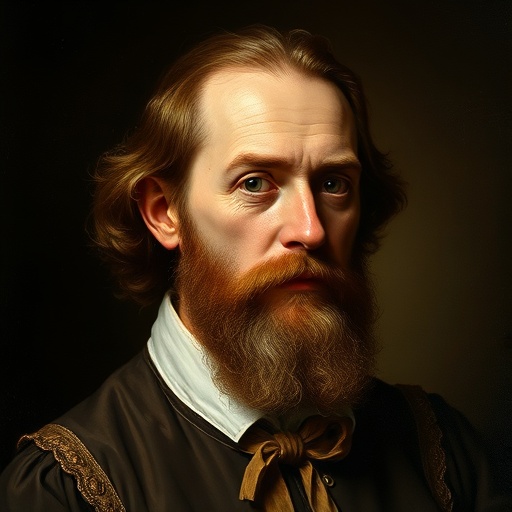
English physician whose On the Motion of the Heart and Blood in Animals (1628) demonstrated blood circulation, overturning 1,400 years of Galenic medicine. Closely associated with Francis Bacon (his contemporary in the new English empiricism). For an intellectual contrast, see Galenic medicine, the 2nd-century Greek medical tradition (humors, blood-as-consumed-fuel) — Harvey calculated that the heart pumps more blood per hour than the body could possibly produce as fuel — a single quantitative observation that demolished the entire Galenic-Aristotelian medical worldview. The cleanest example in medical history of arithmetic disproving 14 centuries of authority.
Found in 1 providers: grok
1 source checked
Blood exits the heart's right ventricle, travels through the lungs where it exchanges carbon dioxide for oxygen, then returns to the heart's left auricle — now called the left atrium. This describes the pulmonary circuit, one of two loops in the cardiovascular system. It establishes the lungs not merely as breathing bellows but as an active station where blood is refreshed before being pumped throughout the rest of the body.
Harvey's 1628 masterwork De Motu Cordis overturned 1,400 years of Galenic medicine by proving blood circulates in a closed loop driven by the heart. As physician to King James I and King Charles I, he had access to resources enabling extensive dissection. This quote captures his central finding: the heart is a mechanical pump, and blood travels a defined anatomical route through the lungs and body rather than being continuously produced and consumed.
In the early 17th century, Galen's second-century theory — that the liver perpetually generates blood consumed by organs — was unquestioned medical orthodoxy. The Scientific Revolution was upending ancient authority through systematic observation and experiment. Harvey practiced as human dissection was becoming more legally and institutionally available across Europe, the printing press was accelerating the spread of heterodox ideas, and quantitative reasoning was beginning to replace philosophical speculation in natural philosophy.
AI-generated insights based on extensive research and information for context. Factual errors? Email [email protected].
Your cart is empty