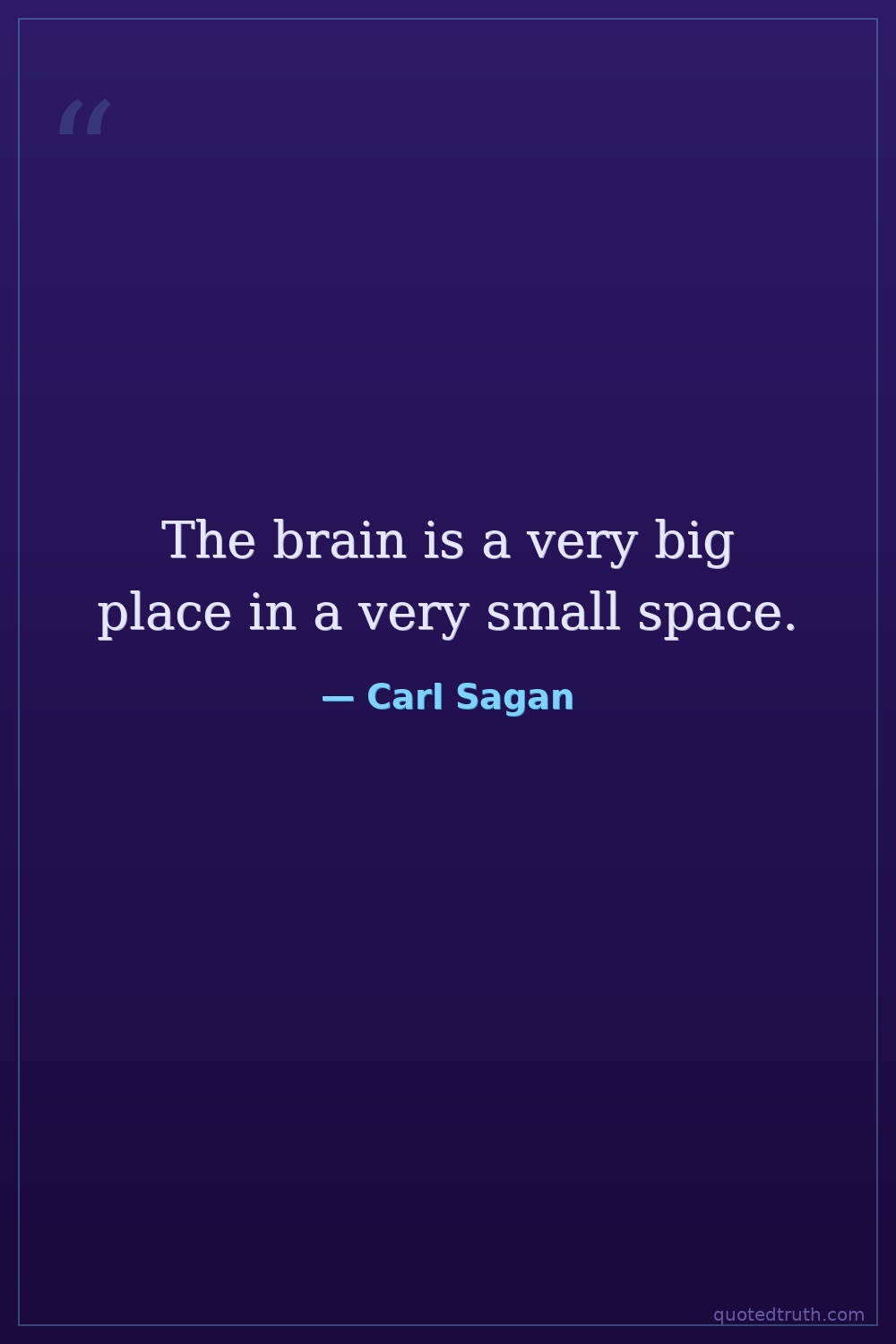
Carl Sagan — "The brain is a very big place in a very small space."
The brain is a very big place in a very small space.
The brain is a very big place in a very small space.
Click any product to generate a realistic preview. Up to 3 at a time.
* Initial load can take up to 90 seconds — revising the preview in another color is nearly instant.
"The notion that the pre-Copernican Earth was flat is a common misconception."
"The beauty of a living thing is not the atoms that go into it, but the way those atoms are put together."
"Every star in the sky is a sun, many with planets, and perhaps life."
"The universe is a pretty big place. If it's just us, it seems like an awful waste of space."
"Science is a self-correcting process."
From 'The Dragons of Eden: Speculations on the Evolution of Human Intelligence'.
Date: 1977
Nature & WorldFound in 1 providers: grok
1 source checked
The human brain, physically small enough to hold in your hands, contains more complexity than almost anything else in the universe. It stores every memory, generates every thought, imagines infinite worlds, and produces consciousness itself. The quote captures the paradox: the most expansive thing we know — the mind — is packed into roughly three pounds of tissue. The inner cosmos rivals the outer one.
Sagan built his career on the tension between cosmic scale and human significance. He famously argued we are 'star stuff' on a 'pale blue dot' — physically tiny, yet capable of understanding the universe. This quote mirrors that philosophy: the brain, like Earth in space, is physically negligible but astronomically rich in what it contains. His work in Cosmos and The Dragons of Eden directly explored consciousness, memory, and the mind's extraordinary depth.
During Sagan's era — the Cold War and Space Race — humanity was simultaneously reaching outward to the cosmos and turning inward to understand consciousness. Neuroscience was emerging as a formal discipline, with early brain-scanning technology arriving in the 1970s-80s. Debates raged about artificial intelligence, what made humans unique, and whether machines could replicate thought. Sagan's era was defined by the question of what the mind truly is and how much it can achieve.
AI-generated insights based on extensive research and information for context. Factual errors? Email [email protected].
Your cart is empty