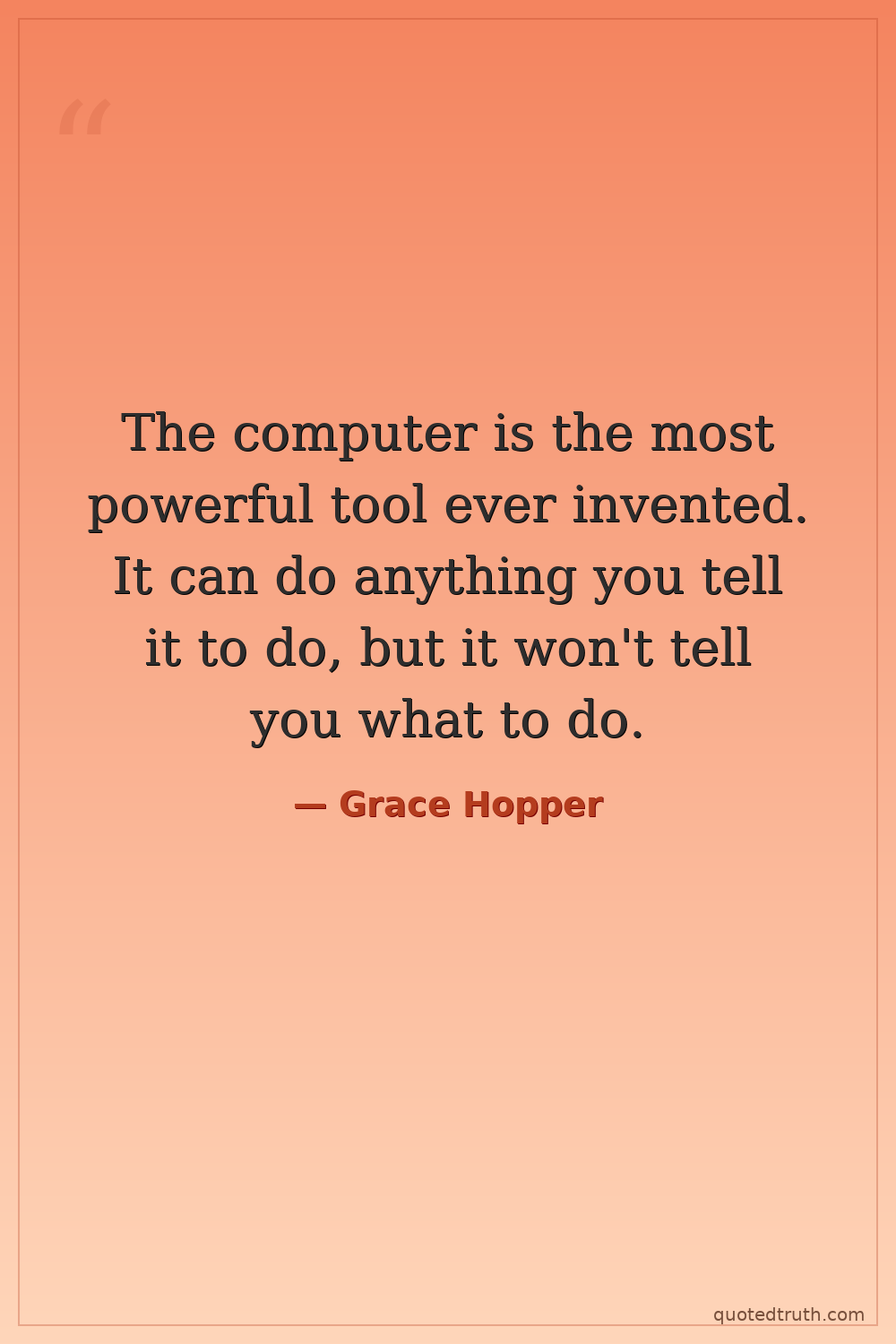
Grace Hopper — "The computer is the most powerful tool ever invented. It can do anything you tel…"
The computer is the most powerful tool ever invented. It can do anything you tell it to do, but it won't tell you what to do.
The computer is the most powerful tool ever invented. It can do anything you tell it to do, but it won't tell you what to do.
Click any product to generate a realistic preview. Up to 3 at a time.
* Initial load can take up to 90 seconds — revising the preview in another color is nearly instant.
"I'm going to retire when I'm 100."
"That's why I'm still here. I enjoy it."
"They don't teach you that in school. You learn it by doing it."
"If you do something once, people will call it an accident. If you do it twice, they call it a coincidence. But do it a third time and you've just proven a natural law!"
"You manage things; you lead people."
Found in 1 providers: grok
1 source checked
Computers are extraordinarily capable machines that execute any instruction given to them with precision and speed. However, they are fundamentally passive — they have no goals, no will, no judgment. They depend entirely on humans to define tasks and decide what matters. Human intelligence, purpose, and decision-making remain irreplaceable; the machine is only as meaningful as the direction a person gives it.
Hopper spent decades programming early computers — UNIVAC, COBOL, the first compiler. She understood better than almost anyone what it meant to tell a computer what to do, having built her career translating human intent into machine instructions. She championed making programming accessible to non-mathematicians because she believed humans must stay in command. This quote distills her professional philosophy: the machine amplifies human will, never replaces it.
In Hopper's era, early mainframes like ENIAC and UNIVAC sparked both wonder and deep anxiety. Automation fears ran high — would machines eliminate human thinking and jobs? Cold War pressures accelerated computing's military adoption while society lacked frameworks for human-computer relationships. Hopper's insistence on human primacy countered both techno-utopianism and techno-fatalism, grounding the conversation in practical reality: computers are tools, not autonomous agents.
AI-generated insights based on extensive research and information for context. Factual errors? Email [email protected].
Your cart is empty