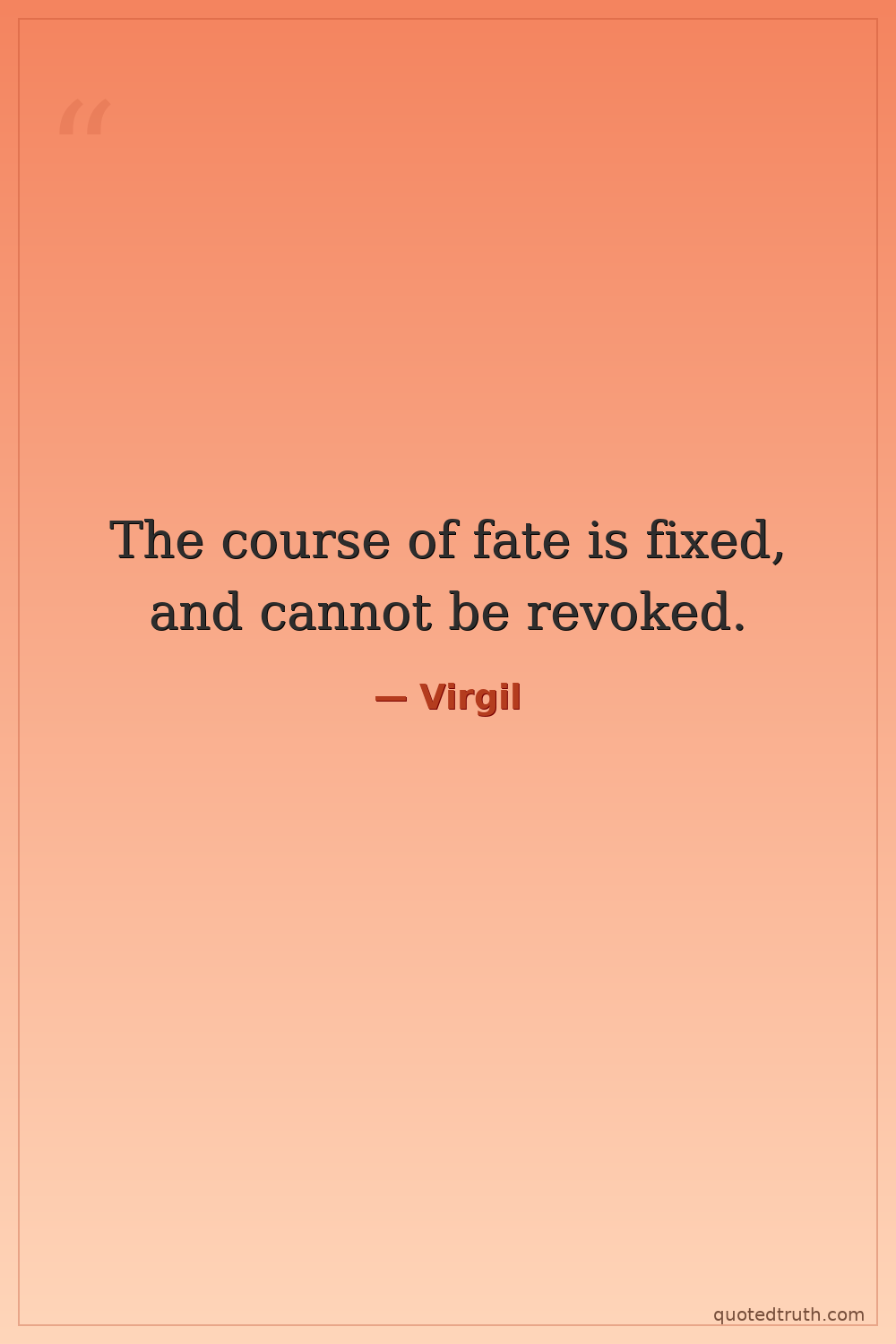
Virgil — "The course of fate is fixed, and cannot be revoked."
The course of fate is fixed, and cannot be revoked.
The course of fate is fixed, and cannot be revoked.
Click any product to generate a realistic preview. Up to 3 at a time.
* Initial load can take up to 90 seconds — revising the preview in another color is nearly instant.
"Stat sua cuique dies; breve et irreparabile tempus omnibus est vitae."
"Numquam omnes hodie moriemur inulti."
"Be not afraid of the shadows, for they only mean there is a light shining somewhere near."
"Quo fata trahunt retrahuntque, sequamur."
"No other evil we know is faster than Rumor, thriving on speed and becoming stronger by running. Small and timid at first, then borne on a light air, she flits over ground while hiding her head on a cl…"
Roman poet of the Augustan age whose Aeneid is the founding national epic of Rome and Western literature's most-imitated hexameter poem. Closely associated with Ovid (younger Augustan poet of Metamorphoses) and Horace (third Augustan-era major poet). For an intellectual contrast, see Lucan, Roman poet (39-65 CE) of the Pharsalia — Lucan's Pharsalia explicitly rejected Virgilian Augustan epic by writing a civil-war epic that refused divine machinery and treated Roman empire as tragedy rather than destiny. Lucan's Pharsalia is a 60-years-later rebuke of the Aeneid's imperial theology — civil war as crime instead of providence.
Your cart is empty