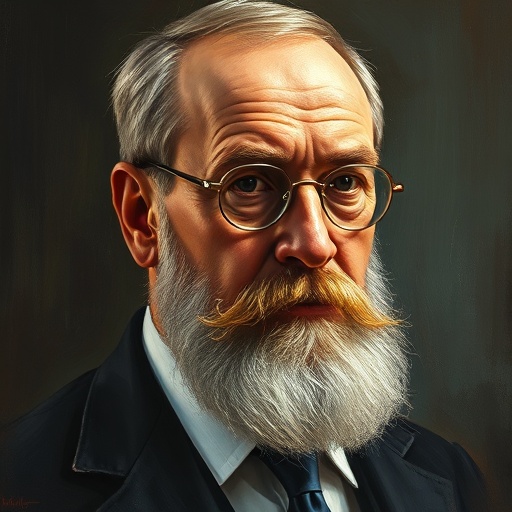
Robert Koch — "The existence of microorganisms as a cause of disease is no longer a matter of t…"
The existence of microorganisms as a cause of disease is no longer a matter of theory, but a demonstrated fact.
The existence of microorganisms as a cause of disease is no longer a matter of theory, but a demonstrated fact.
Click any product to generate a realistic preview. Up to 3 at a time.
* Initial load can take up to 90 seconds — revising the preview in another color is nearly instant.
"I have devoted my life to the study of bacteria, and I have found it to be a most rewarding pursuit."
"The most important thing in scientific research is to observe carefully and think clearly."
"A disease is not an entity, but a process."
"I have worked like a man possessed, but not for fame or money."
"The idea that diseases of humans and animals are fundamentally different is erroneous."
Found in 1 providers: grok
1 source checked
This declaration marks the moment microbial causation of disease crossed from hypothesis into verified fact. Koch is rejecting the prevailing miasma theory — that bad air or imbalance caused illness — replacing it with experimental proof that specific microorganisms produce specific diseases. In plain terms: tiny living organisms cause sickness, and we can prove it in a laboratory. This shift made modern medicine possible, enabling targeted treatments, vaccines, and public health interventions built on reproducible scientific evidence.
Koch spent decades converting germ theory from philosophical argument into laboratory proof. He isolated the anthrax bacillus lifecycle in 1876, identified Mycobacterium tuberculosis in 1882 — earning him the 1905 Nobel Prize — and discovered Vibrio cholerae in 1883. His four postulates provided a universal framework for proving microbial causation. This quote captures his core identity: a meticulous experimentalist who believed science must demonstrate, not merely theorize. Every major discovery of his career was built on that insistence.
In the 1870s–1890s, tuberculosis killed one in seven Europeans and cholera swept continents in repeated pandemics. Medicine still debated whether disease arose from miasmas, divine punishment, or spontaneous generation. Pasteur had theorized microbial causation but lacked definitive proof of mechanism. Rapid industrialization packed workers into unsanitary cities, making epidemic control urgent. Proving that a specific bacterium caused a specific disease gave governments and physicians a concrete, actionable target for the first time.
AI-generated insights based on extensive research and information for context. Factual errors? Email [email protected].
Your cart is empty