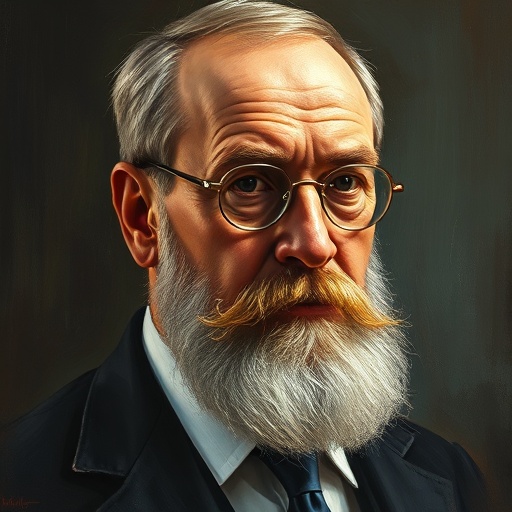
Robert Koch — "The experimental method is the foundation of all scientific progress."
The experimental method is the foundation of all scientific progress.
The experimental method is the foundation of all scientific progress.
Click any product to generate a realistic preview. Up to 3 at a time.
* Initial load can take up to 90 seconds — revising the preview in another color is nearly instant.
"The role of bacteria in disease was a revolutionary concept at the time."
"If my work has any value, it lies in the method, not in the result."
"The struggle against infectious diseases is one of the most important tasks of mankind."
"The microbes are always there; it is the soil that changes."
"As soon as I had found the tubercle bacillus, I found it also in the sputum of phthisical patients."
Found in 1 providers: grok
1 source checked
Controlled experimentation — forming a hypothesis, testing it systematically, and observing repeatable results — is how science actually moves forward. Without it, claims stay speculation. Progress demands hands-on trials and evidence-based conclusions rather than theory or authority alone. Knowledge comes from doing and proving, not assuming. This is a defense of empiricism: if you cannot test it and reproduce it, you cannot call it science.
Koch built his entire career on this principle. He developed Koch's Postulates, a four-step experimental framework proving specific microbes cause specific diseases — replacing guesswork with reproducible proof. His 1882 isolation of Mycobacterium tuberculosis used pure cultures, staining techniques, and animal trials he designed himself. Every major discovery he made — TB, cholera, anthrax — came through disciplined lab experimentation. His 1905 Nobel Prize was a direct reward for trusting the method above all else.
Koch worked during the 1870s–1900s, when medicine was abandoning miasma theory — the idea that disease arose from foul air — for germ theory. Tuberculosis killed one in seven Europeans; cholera swept continents. Laboratory science was new and deeply contested by practicing physicians who distrusted it. Koch's insistence on experimental proof over clinical intuition helped legitimize microbiology as a discipline and forced public health institutions to reorganize around evidence rather than tradition.
AI-generated insights based on extensive research and information for context. Factual errors? Email [email protected].
Your cart is empty