Richard Feynman — "The fact that I can even ask the question, 'What is the mind?' means that the mi…"
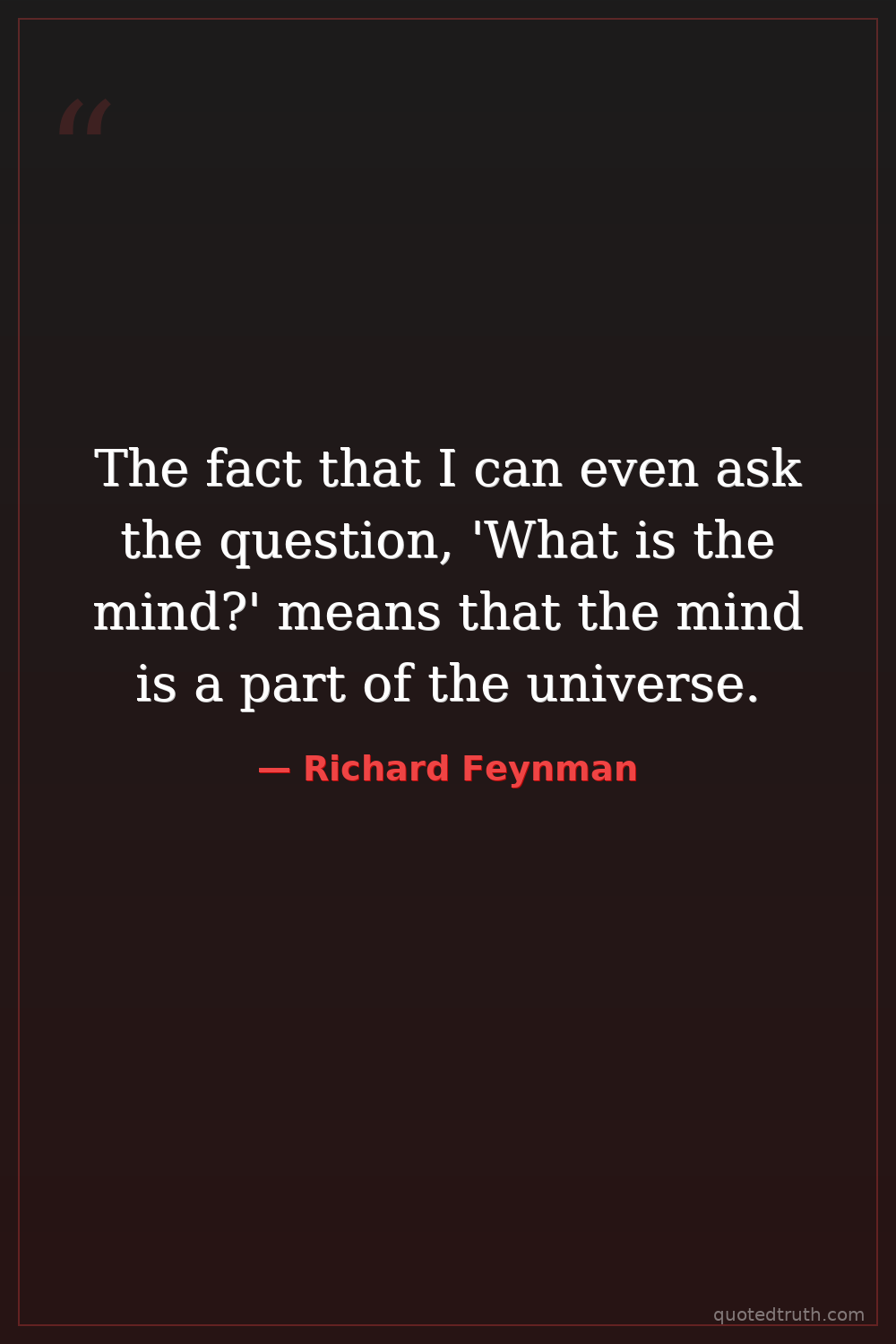
The fact that I can even ask the question, 'What is the mind?' means that the mind is a part of the universe.
The fact that I can even ask the question, 'What is the mind?' means that the mind is a part of the universe.
Click any product to generate a realistic preview. Up to 3 at a time.
* Initial load can take up to 90 seconds — revising the preview in another color is nearly instant.
"If I could explain it to the average person, I wouldn't have been worth the Nobel Prize."
"I don't like to be called 'Professor Feynman.' I like to be called 'Dick.'"
"The purpose of computing is insight, not numbers."
"I was born not knowing and have had only a little time to change that here and there."
"I don't have to be polite when I'm doing science."
American theoretical physicist who shared the 1965 Nobel for QED, developed Feynman diagrams, and wrote the Feynman Lectures on Physics. Closely associated with Julian Schwinger (co-Nobelist for QED) and Murray Gell-Mann (Caltech rival and Eightfold-Way physicist). For an intellectual contrast, see Deepak Chopra, physician and quantum-mysticism author — Feynman's Caltech 'cargo cult science' commencement address is the precise template for what he saw as misuse of physics terminology — Chopra-style appropriation of quantum vocabulary for metaphysical claims is the canonical example of what Feynman called 'fooling yourself'.
Found in 1 providers: grok
1 source checked
The very act of questioning consciousness proves that consciousness exists within the physical universe. If the mind could ask about itself, it cannot be separate from nature — it must be a natural phenomenon subject to scientific inquiry, just like atoms, gravity, or light. Self-awareness is not mystical; it is evidence that matter can reflect on itself.
Feynman devoted his career to understanding nature through rigorous physics, winning the Nobel Prize for quantum electrodynamics. He was famously suspicious of vague philosophy yet deeply curious about consciousness. This quote reflects his signature move: using simple logical observation to collapse a seemingly profound mystery into a straightforward scientific question about the physical world.
Feynman worked through mid-20th century America, when neuroscience was nascent, computers were emerging, and debates about artificial intelligence and consciousness were intensifying. The mind-body problem was shifting from purely philosophical territory into empirical science. His framing anticipated later cognitive science and the computational theories of mind that would dominate late-20th century thinking.
AI-generated insights based on extensive research and information for context. Factual errors? Email [email protected].
Your cart is empty