Zoroaster — "The first step to the Good Religion is to become a foe unto the Lie and a friend…"
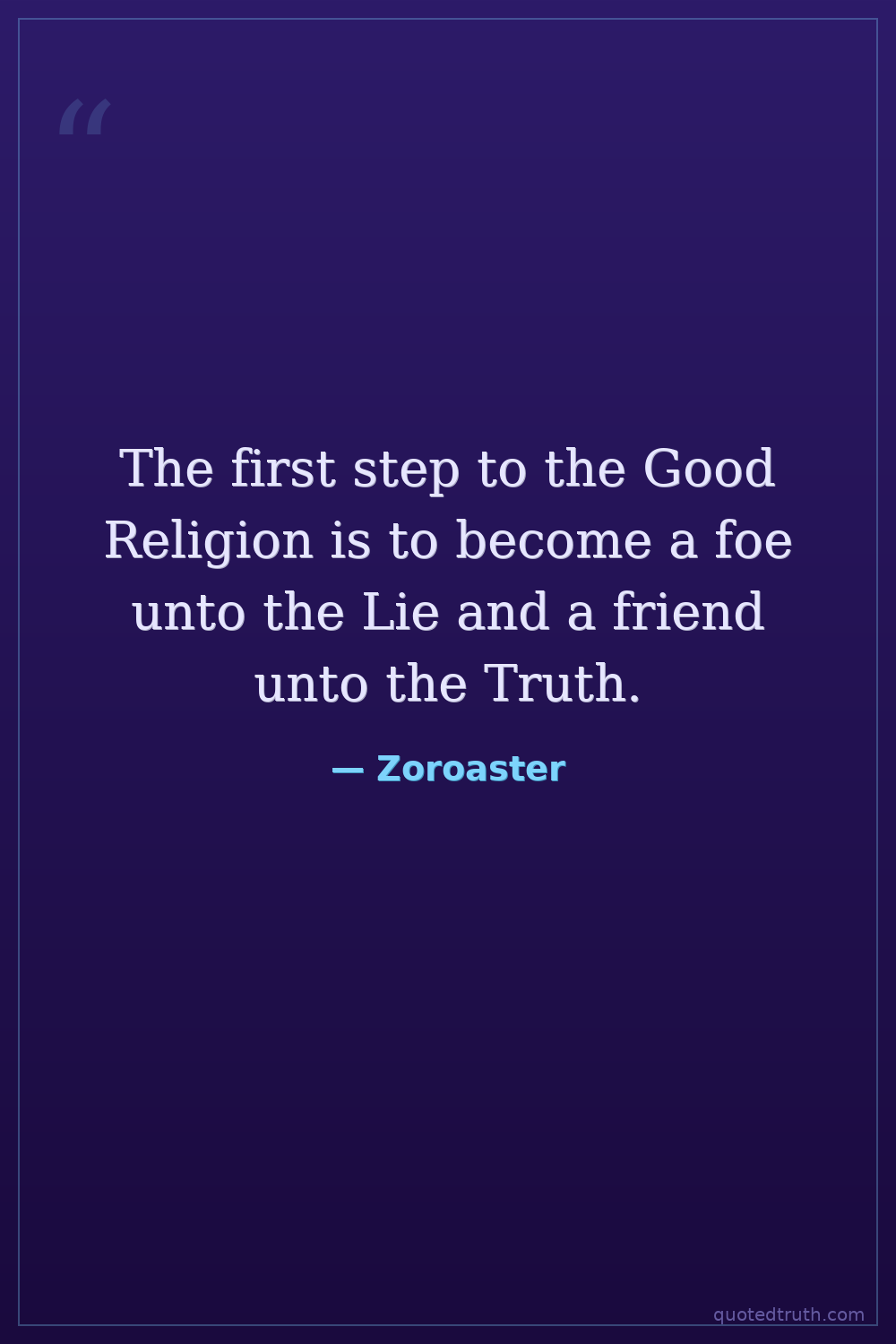
The first step to the Good Religion is to become a foe unto the Lie and a friend unto the Truth.
The first step to the Good Religion is to become a foe unto the Lie and a friend unto the Truth.
Click any product to generate a realistic preview. Up to 3 at a time.
* Initial load can take up to 90 seconds — revising the preview in another color is nearly instant.
"And the evil ones shall be led to their ruin, but the good ones shall come to their reward."
"And thus we two, my soul and the soul of creation, prayed with hands outstretched to the Lord; And thus we two urged Mazda with these entreaties: 'Let not destruction overtake the right-living, Let no…"
"When we are in doubt whether an action is good or bad, abstain from it."
"The reward for righteousness is happiness, and for wickedness, unhappiness."
"The liar shall perish, but the truthful shall dwell in the House of Song."
Iranian prophet who founded Zoroastrianism, the first major religion of cosmic dualism between good (Ahura Mazda) and evil (Angra Mainyu). Closely associated with The Buddha (near-contemporary Eastern moral-cosmological revolutionary). For an intellectual contrast, see Friedrich Nietzsche, German philosopher of 'beyond good and evil' — Nietzsche appropriated Zarathustra's name for Thus Spoke Zarathustra (1883) precisely to invert the original's moral cosmology — the historical Zoroaster founded the good-versus-evil framework Nietzsche's character announces the end of.
Found in 1 providers: deepseek
1 source checked
Embracing a righteous way of life begins with a clear moral choice: reject deception and align yourself with what is true. Before rituals, prayers, or deeper spiritual practice, you must commit to honesty as a personal stance. Treat falsehood as an enemy to actively oppose, and treat truth as an ally to defend. Ethics precedes ceremony, and sincerity is the foundation on which any genuine spiritual path is built.
Zoroaster built his entire theology around the cosmic struggle between Asha (truth, order) and Druj (the Lie, chaos). As a reforming priest who broke from polytheistic Iranian tradition, he taught that each person chooses sides in this battle through thought, word, and deed. This saying distills his core doctrine: the Good Religion he founded is not primarily about sacrifice or caste, but about personal allegiance to truth against deception.
In the second millennium BCE on the Iranian plateau, religion centered on ritual sacrifice, priestly hierarchies, and many nature gods shared with Vedic culture. Raiding, cattle theft, and broken oaths plagued pastoral society. Zoroaster's emphasis on truth versus the Lie challenged ritualism by making ethical integrity the heart of piety, a revolutionary reframing that later influenced Persian imperial law, Judaism, Christianity, and Islam through concepts of dualism and moral accountability.
AI-generated insights based on extensive research and information for context. Factual errors? Email [email protected].
Your cart is empty