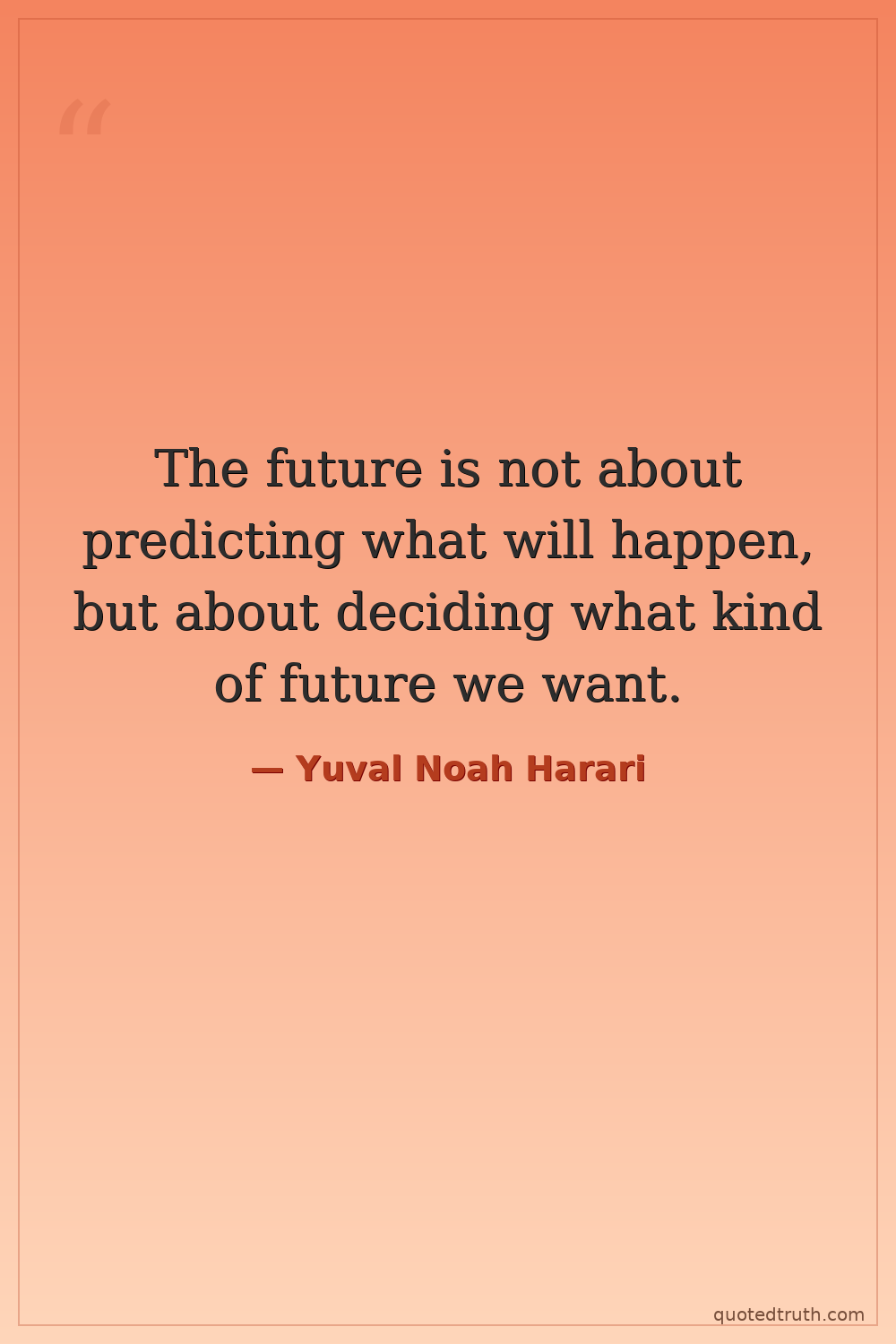
Yuval Noah Harari — "The future is not about predicting what will happen, but about deciding what kin…"
The future is not about predicting what will happen, but about deciding what kind of future we want.
The future is not about predicting what will happen, but about deciding what kind of future we want.
Click any product to generate a realistic preview. Up to 3 at a time.
* Initial load can take up to 90 seconds — revising the preview in another color is nearly instant.
"The future is not about human versus machine, it's about a small elite of humans with machines against the rest of humanity."
"Most people don’t really want freedom because freedom entails responsibility, and responsibility is frightening."
"We are constantly upgrading ourselves, but we don't know what we want to upgrade ourselves into."
"The greatest danger is not that AI will become evil, but that it will become too good at optimizing for something we don't really want."
"The idea of a stable, authentic self is a modern myth."
Israeli historian whose Sapiens (2011) and Homo Deus (2015) reframed big history for a mass audience and sold tens of millions of copies. Closely associated with Jared Diamond (Guns, Germs, and Steel author and Harari's clearest intellectual ancestor) and Steven Pinker (data-driven optimist contemporary). For an intellectual contrast, see Jordan Peterson, Canadian psychologist and Maps of Meaning author — Peterson's Maps of Meaning argues that religious-mythological structure is the load-bearing architecture of human meaning — exactly the framing Harari's 'religion as useful fiction' thesis treats as historically transitory. The two are the largest-platform popular intellectuals of the 2010s with opposite views on whether religion encodes deep truth.
Your cart is empty