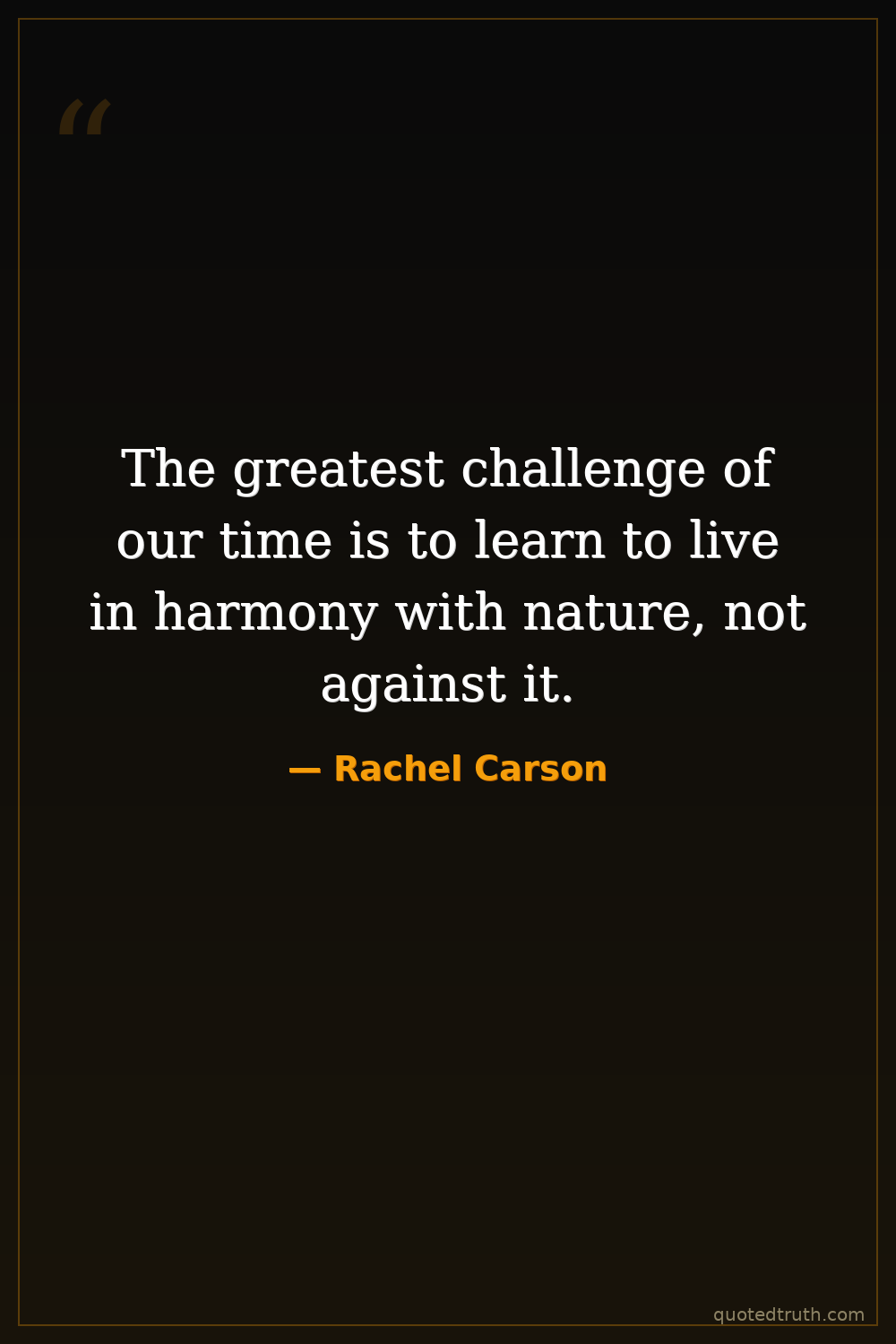
Rachel Carson — "The greatest challenge of our time is to learn to live in harmony with nature, n…"
The greatest challenge of our time is to learn to live in harmony with nature, not against it.
The greatest challenge of our time is to learn to live in harmony with nature, not against it.
Click any product to generate a realistic preview. Up to 3 at a time.
* Initial load can take up to 90 seconds — revising the preview in another color is nearly instant.
"I am not afraid of controversy; I am afraid of silence in the face of such a grave threat."
"It is not my intention to create hysteria, but to awaken people to the dangers that exist."
"Future generations are not going to forgive us for the way we are destroying the planet."
"The public is being misled, and it is a scandal of the highest order."
"Who has the time to feel the earth beneath their feet, or the wind in their hair, or the sun on their face?"
Found in 1 providers: grok
1 source checked
The quote argues humanity's defining struggle is not technological conquest but learning to coexist with natural systems. Living against nature—through chemical pollution, habitat destruction, and industrial overreach—produces long-term collapse. True progress means sustaining the ecosystems humans depend on. The framing as our time emphasizes urgency: this is not a timeless philosophical musing but an active crisis requiring immediate reorientation of how civilization relates to the living world.
Carson was a marine biologist who spent decades studying coastal ecosystems before writing Silent Spring (1962), which documented how DDT and synthetic pesticides cascaded devastatingly through food chains. She challenged powerful agrochemical corporations while battling breast cancer, embodying the conviction she expressed. Her earlier books—The Sea Around Us, Under the Sea Wind—reveal lifelong reverence for natural systems. This quote distills her core argument: industrial civilization was waging a war on nature it could not survive winning.
Carson worked during the postwar boom when DDT was celebrated as a miracle technology and the slogan better living through chemistry was mainstream ideology. Nuclear testing scattered radioactive fallout globally. Rivers caught fire. Industrial pollution went largely unregulated. Her era preceded the EPA (1970), Clean Air Act, and Clean Water Act. Silent Spring directly sparked the modern environmental movement, leading to the 1972 US DDT ban—proof her framing of humanity versus nature resonated.
AI-generated insights based on extensive research and information for context. Factual errors? Email [email protected].
Your cart is empty