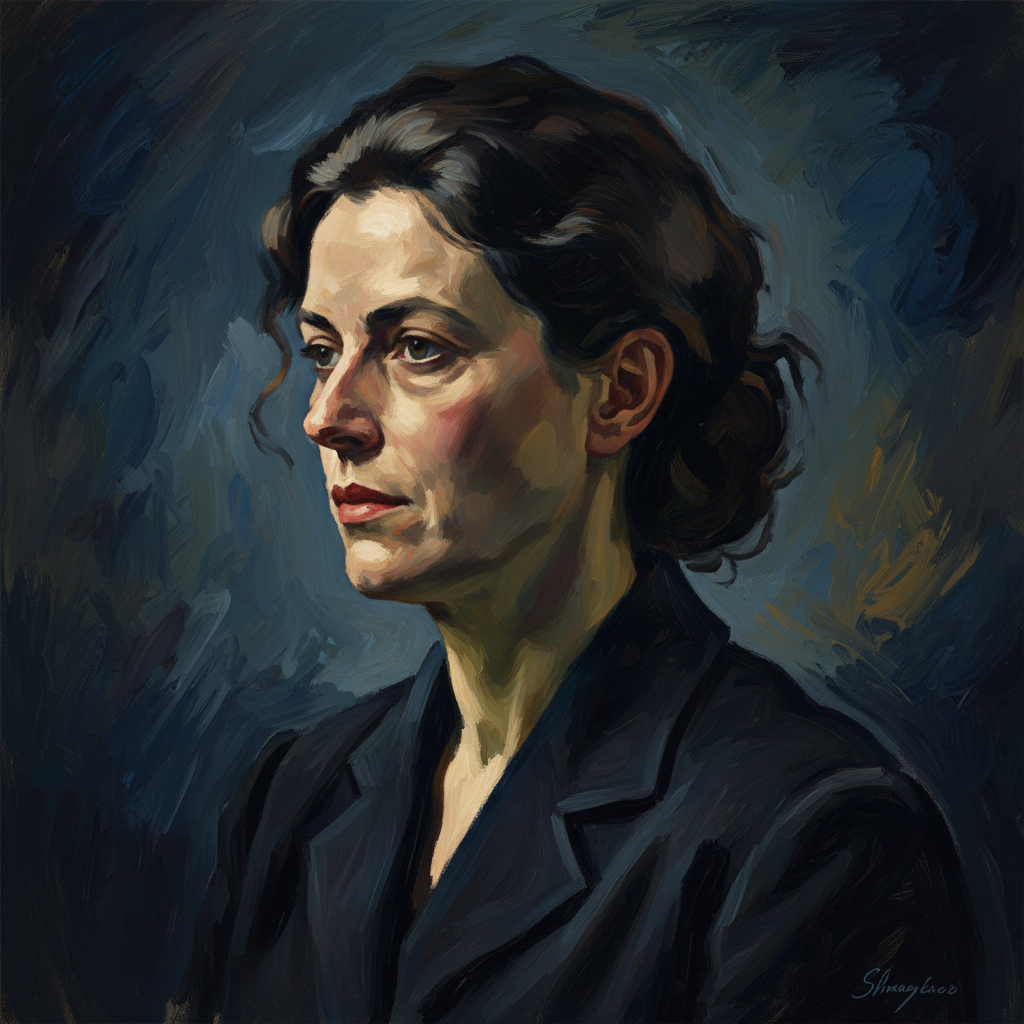
Simone de Beauvoir — "The greatest danger for women is to remain within the domestic sphere."
The greatest danger for women is to remain within the domestic sphere.
The greatest danger for women is to remain within the domestic sphere.
Click any product to generate a realistic preview. Up to 3 at a time.
* Initial load can take up to 90 seconds — revising the preview in another color is nearly instant.
"I wish that every human life might be an acceptable poem."
"The best way to predict the future is to create it."
"The greatest freedom is to be oneself."
"If we are to abolish the slavery of women, the first step is to abolish the family."
"The world is not a collection of things, but a collection of relationships."
French existentialist philosopher whose The Second Sex (1949) is the foundational text of modern feminist theory. Closely associated with Jean-Paul Sartre (lifetime partner and existentialist co-founder) and Albert Camus (existentialist contemporary in Paris). For an intellectual contrast, see Camille Paglia, American cultural critic and Sexual Personae author — Paglia argues for biological-essentialist roots of gender that Beauvoir's social-construction view — 'one is not born, but rather becomes, a woman' — explicitly rejects. The two are the cleanest constructed-vs-essentialist poles in feminist theory.
The standard scholarly entry points to Simone de Beauvoir's work: Toril Moi (Duke, James B. Duke Distinguished Professor) — Simone de Beauvoir: The Making of an Intellectual Woman (1994); Margaret A. Simons (Southern Illinois University, Emerita) — Beauvoir and The Second Sex (1999); Kate Kirkpatrick (Oxford, Regent's Park College) — Becoming Beauvoir: A Life (2019). These are the works graduate seminars cite when teaching Simone de Beauvoir.
Your cart is empty