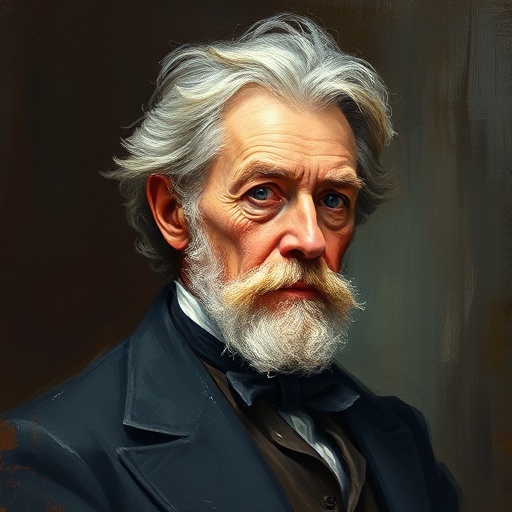
Michael Faraday — "The greatest discovery is to find that which has always been there, but has neve…"
The greatest discovery is to find that which has always been there, but has never been seen.
The greatest discovery is to find that which has always been there, but has never been seen.
Click any product to generate a realistic preview. Up to 3 at a time.
* Initial load can take up to 90 seconds — revising the preview in another color is nearly instant.
"I have often been accused of being a dreamer, but I have found that dreams can become reality."
"I have been working for some time on the subject of electricity and magnetism, and I think I have made some discoveries."
"But still try, for who knows what is possible?"
"The very best way to learn is to do."
"The greatest enemy of knowledge is not ignorance, it is the illusion of knowledge."
Attributed, emphasizing the importance of new perspectives.
Date: Mid 19th Century (approx.)
EducationalFound in 1 providers: grok
1 source checked
True breakthroughs often come from recognizing something that was always present but overlooked. Discovery is less about inventing new things and more about perceiving reality clearly, noticing patterns, connections, or phenomena hiding in plain sight. The quote argues that careful observation and fresh perspective can reveal truths the world has walked past for centuries, reframing what counts as genius: not creation from nothing, but attentive seeing.
Faraday exemplified this idea. A self-taught bookbinder's apprentice with almost no formal math, he uncovered electromagnetic induction by patiently observing wires, magnets, and iron filings that countless others had handled. His discovery of induced current, diamagnetism, and field lines came from rigorous experimentation rather than theoretical leaps. Faraday saw invisible fields threading through ordinary space, turning what was always there into the foundation of electric generators, motors, and modern physics.
Faraday worked in early-to-mid 1800s Britain, during the Industrial Revolution, when steam and mechanization dominated but electricity was a laboratory curiosity. The Royal Institution in London, where he lectured, was making science public. Gentlemen-scientists still dominated, and a working-class experimenter like Faraday was unusual. His era prized empirical observation over speculation, setting the stage for Maxwell to later mathematize Faraday's intuitive field concepts into the equations underpinning modern electromagnetism.
AI-generated insights based on extensive research and information for context. Factual errors? Email [email protected].
Your cart is empty