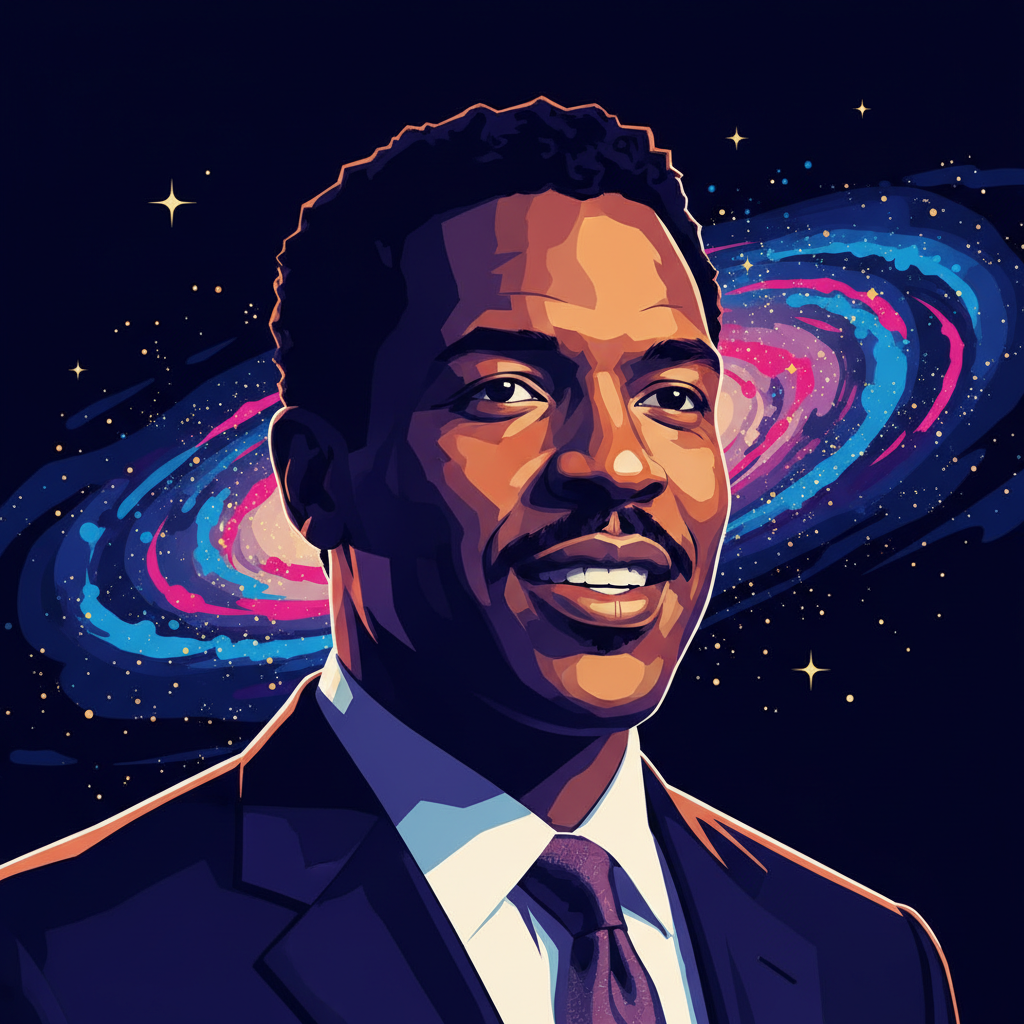
Neil deGrasse Tyson — "The greatest discovery is to find something you love to do and then figure out h…"
The greatest discovery is to find something you love to do and then figure out how to get paid for it.
The greatest discovery is to find something you love to do and then figure out how to get paid for it.
Click any product to generate a realistic preview. Up to 3 at a time.
* Initial load can take up to 90 seconds — revising the preview in another color is nearly instant.
"Knowing how to think empowers you far beyond those who only know what to think."
"I don't have a problem with people believing in God. I have a problem with people believing in things that are demonstrably false."
"I'm not a fan of dogma. I prefer to let the evidence speak for itself."
"My goal is to empower people to use the methods and tools of science to analyze information and come to their own conclusions."
"The universe is not just a bunch of stuff. It's a story, and we're all part of it."
American astrophysicist, Hayden Planetarium director, and Cosmos: A Spacetime Odyssey host who carries the Carl Sagan public-science mantle. Closely associated with Bill Nye (fellow science communicator) and Brian Greene (theoretical physicist and string-theory popularizer). For an intellectual contrast, see Ken Ham, founder of Answers in Genesis and the Creation Museum — Ham's career has been organized around defending biblical 6-day creationism — exactly the science-education position Tyson's mainstream-science communication is structured to refute.
Found in 1 providers: grok
1 source checked
The quote argues that genuine passion should drive career choice above all else. Finding work you love transforms labor into fulfillment — the real discovery is personal, not scientific. The second half adds a pragmatic layer: love alone doesn't pay rent, so the challenge is engineering a livelihood around that passion rather than abandoning it for a safer, more conventional path driven purely by income.
Tyson fell in love with the cosmos as a Bronx kid after visiting the Hayden Planetarium, then built an entire career around that obsession — earning a PhD, becoming the Planetarium's director, and growing into America's most recognized science communicator through books, television, and his StarTalk podcast. His trajectory from fascinated child to paid public scientist is a direct, lived embodiment of this exact principle.
Tyson's prominence spans an era of crushing student debt, a gig economy reshaping careers, and platforms like YouTube and podcasting creating new ways to monetize passion. Simultaneously, science denialism surged, making paid science communicators culturally urgent. Young people faced intense pressure toward lucrative but unfulfilling degrees. His message directly countered that pressure, resonating with a generation asking whether meaningful work and financial survival could realistically coexist.
AI-generated insights based on extensive research and information for context. Factual errors? Email [email protected].
Your cart is empty