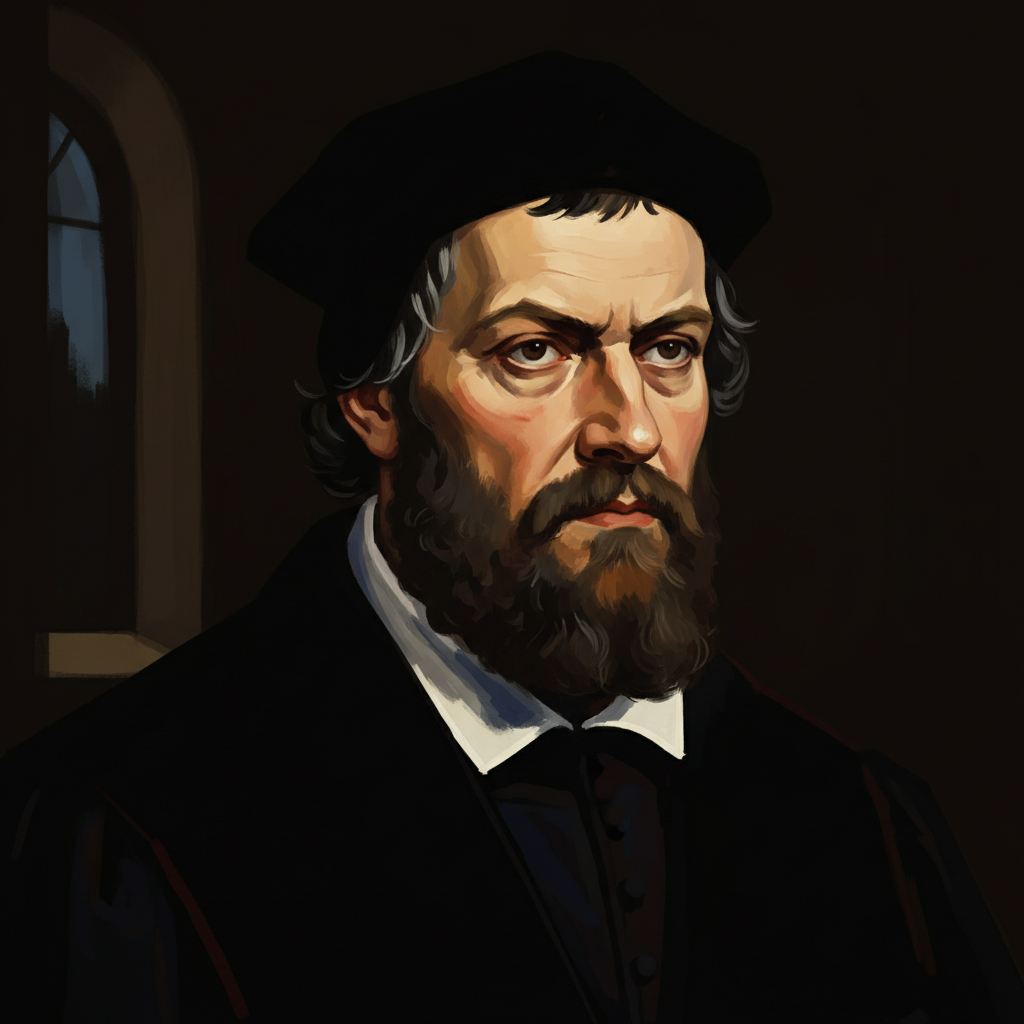
Martin Luther — "The greatest gift of God is a pious, cheerful, God-fearing wife."
The greatest gift of God is a pious, cheerful, God-fearing wife.
The greatest gift of God is a pious, cheerful, God-fearing wife.
Click any product to generate a realistic preview. Up to 3 at a time.
* Initial load can take up to 90 seconds — revising the preview in another color is nearly instant.
"They must be driven from our country."
"You are not only responsible for what you say, but also for what you do not say."
"I am more afraid of my own heart than of the pope and all his cardinals. I have within me the great pope, Self."
"It is not a matter of choice for a woman to be a virgin or not; it is a matter of her destiny."
"The hair is the finest ornament women have."
German theologian whose 95 Theses (1517) launched the Protestant Reformation and broke the Catholic Church's monopoly on Western Christianity. Closely associated with Philipp Melanchthon (Lutheran systematizer) and John Calvin (later Reformer who built on Luther's break). For an intellectual contrast, see Pope Leo X, Renaissance pope (1513-1521) — Leo X's indulgence sales triggered Luther's break and Leo excommunicated him in 1521 — Luther's entire Reformation is structured as a direct answer to the indulgence-funded Vatican Leo represented.
Found in 1 providers: grok
1 source checked
Luther is saying that among all blessings, nothing surpasses having a devoted, joyful, spiritually grounded spouse. A partner who is faithful, good-natured, and respectful of God brings more lasting value to a person's life than wealth, status, or success. He frames marriage itself as a divine gift, with the wife's character, not her beauty or dowry, being what makes the gift extraordinary.
Luther famously married ex-nun Katharina von Bora in 1525, scandalizing Europe by rejecting clerical celibacy. Their partnership became his model of godly marriage. Katharina managed their household, brewed beer, ran a farm, and raised six children, earning Luther's deep affection. He called her 'my lord Katie' and praised her constantly. This quote reflects his lived conviction that marriage, not monasticism, was the true Christian calling.
In early modern Europe, the Catholic Church enforced priestly celibacy and ranked monastic life above marriage spiritually. Luther's Reformation overturned this, elevating marriage as a sacred vocation accessible to all Christians, including clergy. His 1525 wedding was revolutionary propaganda, reshaping Protestant family life for centuries. Amid religious wars, plague, and theological upheaval, the stable Christian household became a Protestant ideal, making praise of a pious wife a deeply political and spiritual statement.
AI-generated insights based on extensive research and information for context. Factual errors? Email [email protected].
Your cart is empty