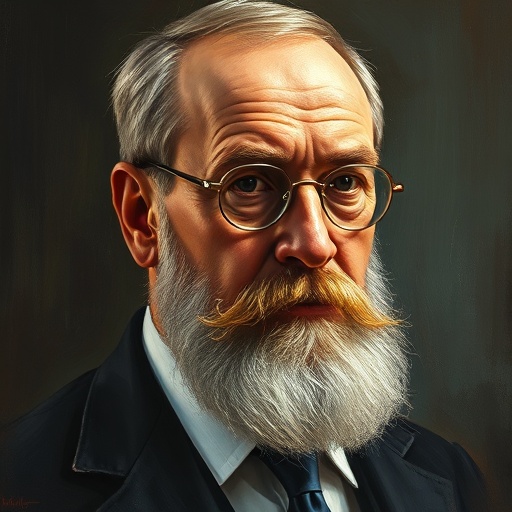
Robert Koch — "The greatest joy of a scientist is to make a new discovery."
The greatest joy of a scientist is to make a new discovery.
The greatest joy of a scientist is to make a new discovery.
Click any product to generate a realistic preview. Up to 3 at a time.
* Initial load can take up to 90 seconds — revising the preview in another color is nearly instant.
"The battle against infectious diseases is a continuous one."
"The future of medicine lies in the prevention of disease, not in its cure."
"I believe that every disease has a specific cause, and that cause can be identified."
"My greatest satisfaction comes from knowing that my discoveries have saved lives."
"My work in Africa on sleeping sickness was particularly challenging."
Found in 1 providers: grok
1 source checked
Scientific discovery carries a unique satisfaction that surpasses other professional rewards. When a researcher uncovers something previously unknown, it produces an almost incomparable intellectual fulfillment. The act of finding out — revealing a truth hidden from all of humanity until that moment — is the deepest motivation driving genuine scientific work, more valuable than recognition, money, or prestige. Discovery itself is the payoff.
Koch personally identified the bacterial causes of tuberculosis (1882), cholera (1883), and anthrax, transforming germ theory from hypothesis into medical fact. He developed pure culture techniques and Koch's Postulates, giving science rigorous tools for linking microbes to disease. Having stood at the microscope confirming the tuberculosis bacillus, this quote reads as autobiographical — the joy of discovery was not abstract philosophy but lived experience repeated across his landmark career.
Koch worked during the 1870s–1900s, when bacteriology was exploding from speculation into hard science. Infectious disease killed millions annually with causes poorly understood. He and Pasteur were simultaneously dismantling miasma theory and building germ theory. The era saw rapid breakthroughs — X-rays, vaccines, antiseptic surgery — and the Nobel Prize launched in 1901 formalized scientific achievement. Public excitement around laboratory science was at an unprecedented high, making discovery culturally electrifying.
AI-generated insights based on extensive research and information for context. Factual errors? Email [email protected].
Your cart is empty