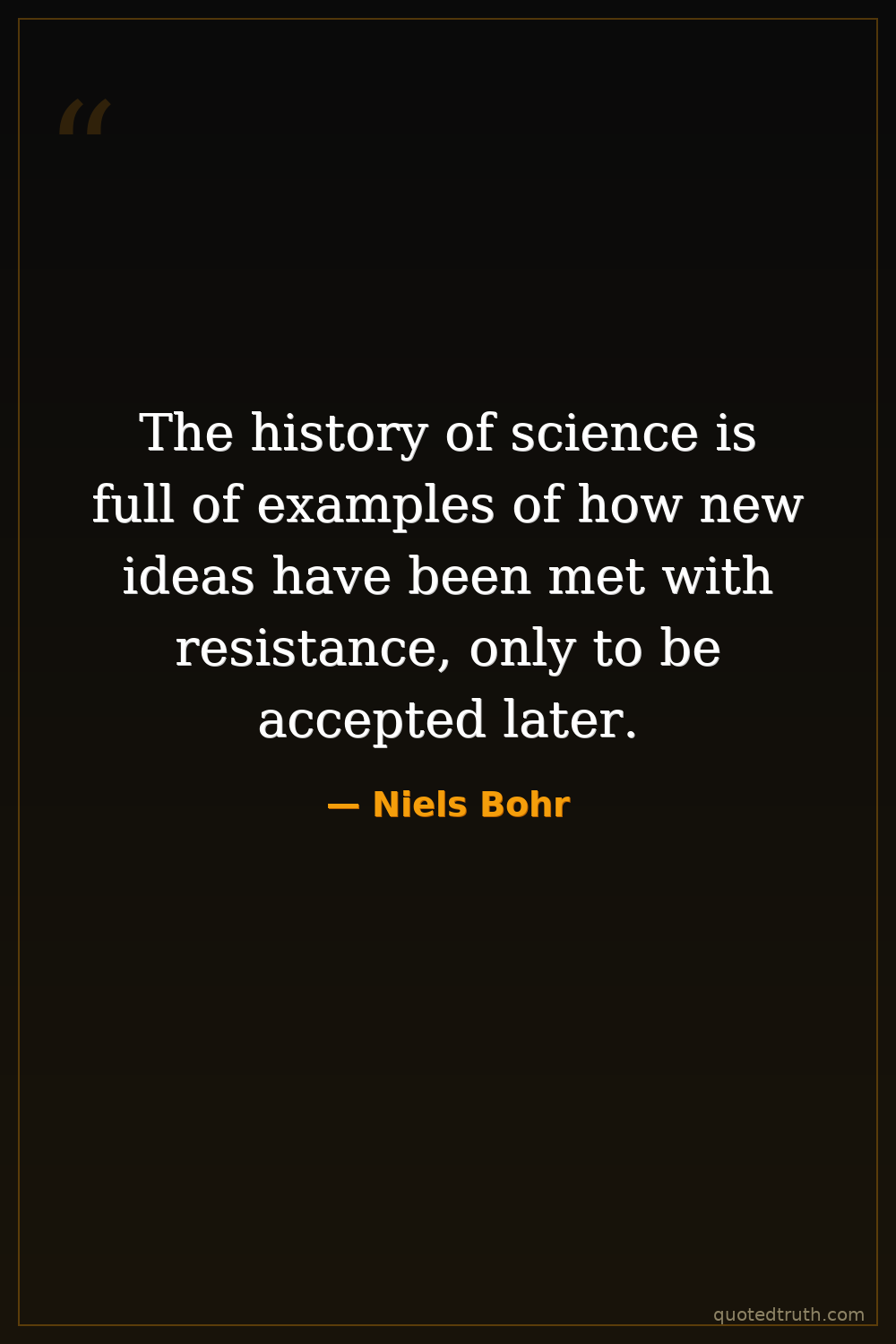
Niels Bohr — "The history of science is full of examples of how new ideas have been met with r…"
The history of science is full of examples of how new ideas have been met with resistance, only to be accepted later.
The history of science is full of examples of how new ideas have been met with resistance, only to be accepted later.
Click any product to generate a realistic preview. Up to 3 at a time.
* Initial load can take up to 90 seconds — revising the preview in another color is nearly instant.
"If quantum mechanics hasn't profoundly shocked you, you haven't understood it yet."
"Every great and deep difficulty bears in itself its own solution. It forces us to change our thinking in order to find it."
"The problem is not to make things simple, but to make them understandable."
"The problem is not to know what the world is, but what we can say about it."
"No, I certainly do not believe in this superstition. But you know, they say that it does bring luck even if you don't believe in it!"
Found in 1 providers: grok
1 source checked
New scientific ideas are routinely rejected at first, then eventually embraced as understanding matures. Scientific progress is not smooth or immediate — it faces friction from entrenched thinking, institutional inertia, and human reluctance to abandon familiar frameworks. What seems radical or wrong to one generation often becomes foundational truth to the next.
Bohr experienced this resistance firsthand. His 1913 atomic model — electrons occupying discrete energy levels, emitting light in quantum jumps — directly contradicted classical physics. Established physicists initially dismissed it. His Copenhagen interpretation of quantum mechanics sparked fierce debate, famously with Einstein, who resisted it until his death. Bohr understood paradigm resistance as a personal lived reality.
Bohr's career (1910s–1950s) coincided with the most disruptive revolution in physics since Newton. Quantum mechanics overthrew determinism and classical causality, challenging Einstein's relativity framework. The scientific establishment struggled enormously to reconcile these theories. Cold War nuclear politics further complicated open scientific exchange, making Bohr's defense of revolutionary ideas both intellectually and politically charged.
AI-generated insights based on extensive research and information for context. Factual errors? Email [email protected].
Your cart is empty