What it means
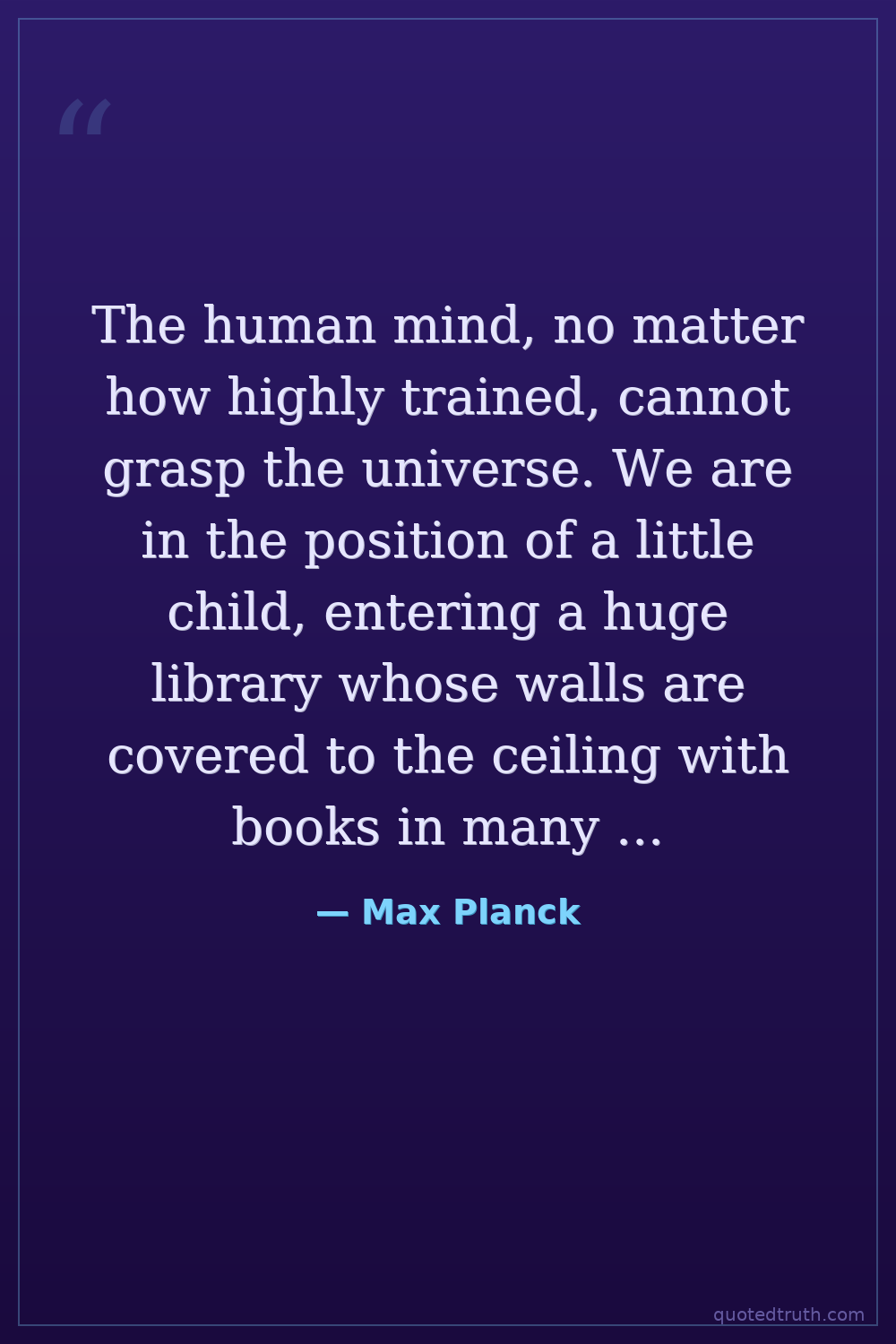
Even the smartest humans cannot fully understand the universe. We're like a child wandering into a vast library full of books in unknown languages. The child senses that an author exists and notices an organized structure, but cannot read the books or grasp the organizing principle. In the same way, our brightest minds can only dimly sense that reality has an author and a hidden order, without ever truly comprehending it.
Relevance to Max Planck
Planck founded quantum theory in 1900 by proposing energy comes in discrete packets, overturning classical physics. Despite unlocking the atom's deepest secrets, he remained humbled by what science could not explain and openly professed belief in an intelligent creator. Raised in a devout Lutheran family and serving as a church elder, he repeatedly argued that science and religion address complementary questions, making this library metaphor a direct expression of his lifelong conviction.
The era
Planck lived through the collapse of classical physics (1900-1947), two world wars, and the Nazi regime that killed his son Erwin for resisting Hitler. As relativity, quantum mechanics, and atomic weapons reshaped the world, many intellectuals embraced strict materialism and declared religion obsolete. Planck's library metaphor pushed back against that triumphalism, insisting that even revolutionary discoveries only deepened the mystery rather than dissolving it, a stance that resonated in a shaken postwar Europe searching for meaning.
AI-generated insights based on extensive research and information for context. Factual errors? Email [email protected].