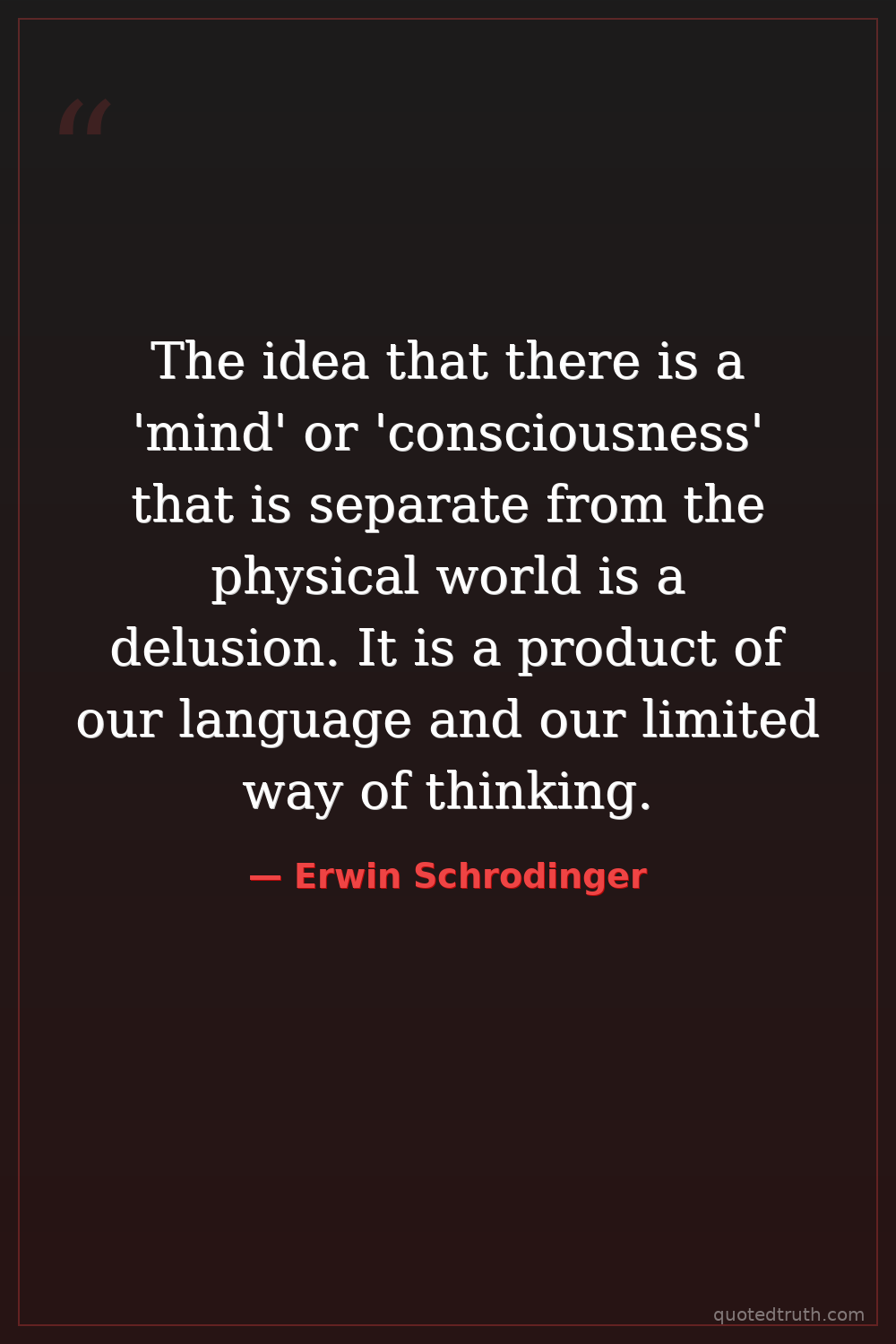
What it means
The belief that your mind exists independently from the physical universe is an illusion we've constructed through imprecise language and cognitive habits. Consciousness isn't a ghost floating above matter — it's something embedded in the physical world. Our intuition that mind and body are separate things is a trick of how we describe experience, not a reflection of how reality actually works.
Relevance to Erwin Schrodinger
Schrödinger spent his career dissolving sharp boundaries — his wave equation replaced particle certainty with probabilistic fields. He wrote 'What is Life?' exploring how physics underlies biology and consciousness. He was deeply influenced by Vedantic philosophy, which similarly rejects subject-object dualism. For Schrödinger, physics and mind were not separate domains but facets of one unified reality he spent his life trying to articulate.
The era
Mid-20th century quantum mechanics had shattered classical determinism, forcing physicists to confront the role of the observer in measurement. Meanwhile, philosophy of mind was debating Cartesian dualism versus materialism. Schrödinger wrote during an era when scientists increasingly encroached on questions previously owned by philosophy and theology, and his generation pioneered treating consciousness as a legitimate scientific problem rather than a metaphysical given.
AI-generated insights based on extensive research and information for context. Factual errors? Email [email protected].