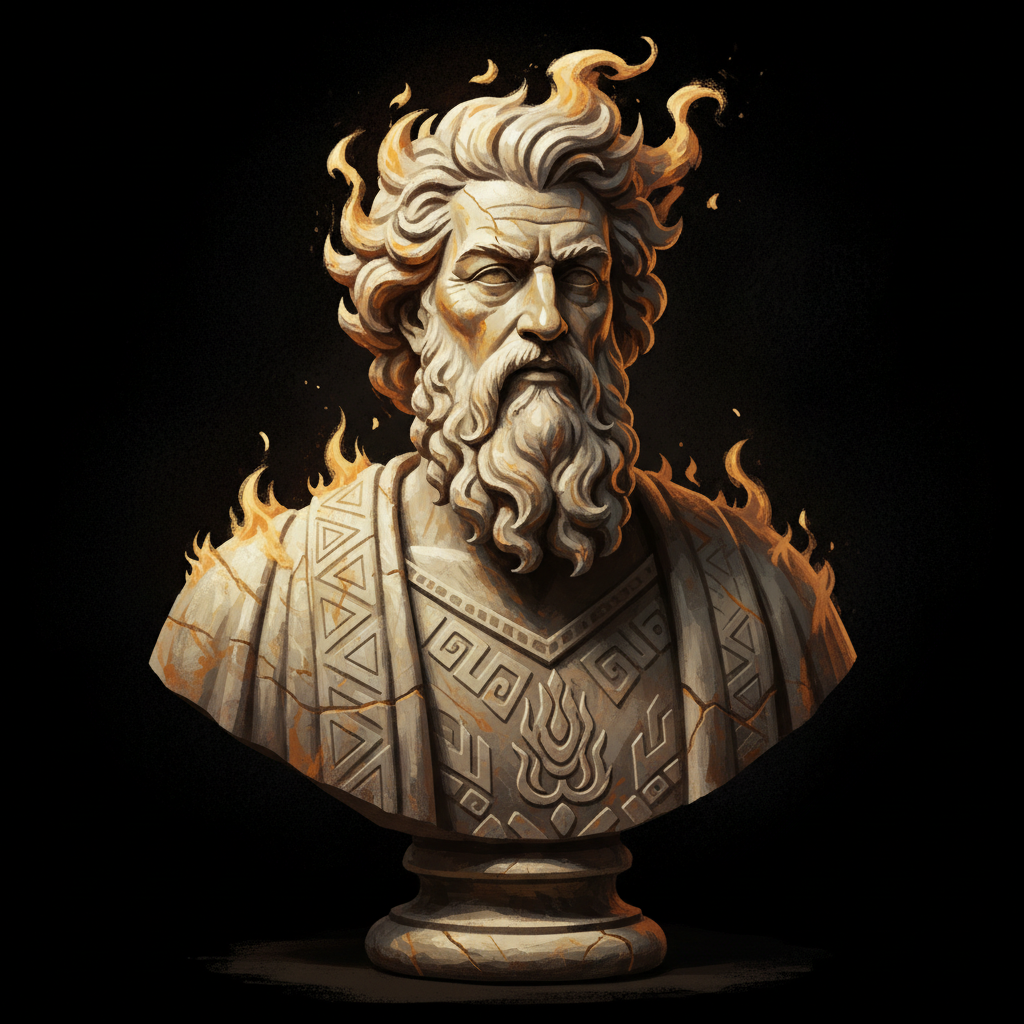
Zoroaster — "The lie-follower is an evil doer, but the truth-follower is a good doer."
The lie-follower is an evil doer, but the truth-follower is a good doer.
The lie-follower is an evil doer, but the truth-follower is a good doer.
Click any product to generate a realistic preview. Up to 3 at a time.
* Initial load can take up to 90 seconds — revising the preview in another color is nearly instant.
"The liar shall perish, but the truthful shall dwell in the House of Song."
"I declare the truth to all who will listen."
"Everything that is created was first a Thought."
"Therefore, let us all be of one mind, and let us strive for the good, and let us reject the evil."
"The reward for righteousness is not merely in the afterlife, but in the present moment through inner peace and joy."
Iranian prophet who founded Zoroastrianism, the first major religion of cosmic dualism between good (Ahura Mazda) and evil (Angra Mainyu). Closely associated with The Buddha (near-contemporary Eastern moral-cosmological revolutionary). For an intellectual contrast, see Friedrich Nietzsche, German philosopher of 'beyond good and evil' — Nietzsche appropriated Zarathustra's name for Thus Spoke Zarathustra (1883) precisely to invert the original's moral cosmology — the historical Zoroaster founded the good-versus-evil framework Nietzsche's character announces the end of.
Found in 1 providers: grok
1 source checked
Your actions define your morality, and those actions flow from what you choose to align yourself with. If you commit to falsehood and deception, you inevitably cause harm through your behavior. If you commit to honesty and reality as it is, you naturally produce beneficial outcomes. Character is not separate from allegiance; whichever principle you follow shapes whether your impact on others is constructive or destructive.
Zoroaster built his entire theological system around the cosmic struggle between Asha (truth, order) and Druj (lie, deception). As a priest-reformer in ancient Iran, he rejected the ritualistic polytheism around him and preached that every person must actively choose sides through thoughts, words, and deeds. This saying distills his founding doctrine: ethical behavior is inseparable from allegiance to truth itself.
Zoroaster lived in Bronze Age Iran (roughly 1500-1000 BCE) amid tribal polytheism, animal sacrifice, and warrior raid culture where might often defined right. Law depended on clan loyalty and ritual purity rather than personal ethics. By reframing morality as a binary choice between truth and lie binding on every individual, Zoroaster introduced one of history's earliest ethical monotheisms, later influencing Judaism, Christianity, and Islam.
AI-generated insights based on extensive research and information for context. Factual errors? Email [email protected].
Your cart is empty