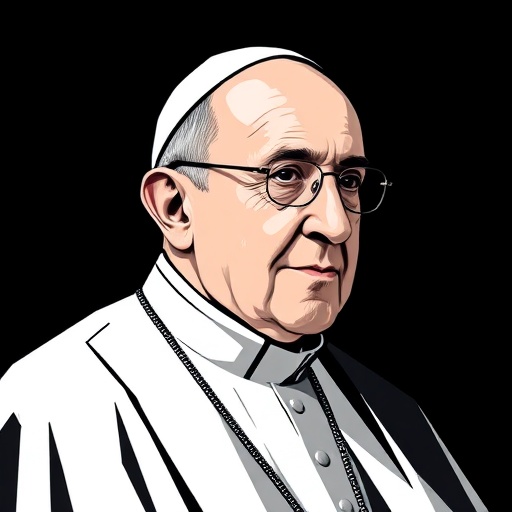
Pope Francis — "The Lord always forgives. We men forgive sometimes. Nature never forgives."
The Lord always forgives. We men forgive sometimes. Nature never forgives.
The Lord always forgives. We men forgive sometimes. Nature never forgives.
Click any product to generate a realistic preview. Up to 3 at a time.
* Initial load can take up to 90 seconds — revising the preview in another color is nearly instant.
"We have to state, without mincing words, that there is an inseparable bond between our faith and the poor."
"If someone is gay and he searches for the Lord and has good will, who am I to judge? We shouldn’t marginalize people for this. They must be integrated into society."
"An economic system that has as its center the god of money needs to be denounced, because it is a system that kills."
"We must not be afraid to be a bit messy, to be a bit untidy. The Church should not be a neat and tidy thing."
"I am not a Hollywood star."
First Latin American and Jesuit pope (2013-), who has steered the Catholic Church toward pastoral inclusion on LGBTQ pastoral care, divorced Catholics, and climate. Closely associated with Pope John XXIII (the Vatican II reformer pope) and Cardinal Walter Kasper (his theological ally on pastoral reform). For an intellectual contrast, see Cardinal Raymond Burke, American traditionalist cardinal, former head of the Vatican Apostolic Signatura — Burke is the public face of Catholic traditionalism that views Francis's pastoral approach as doctrinally dangerous — he has formally challenged Amoris Laetitia and other Francis reforms.
Press conference on board the papal plane returning from the Philippines
Date: 2015
BiblicalFound in 1 providers: grok
1 source checked
Divine forgiveness is unlimited; human forgiveness is conditional and inconsistent; nature operates without mercy at all. When we destroy ecosystems, acidify oceans, or exhaust soil, no regret or repentance reverses the damage. The quote frames ecological responsibility as categorically different from spiritual or interpersonal ethics—consequences in the natural world are permanent and indifferent to human intent, guilt, or reform. Accountability to nature is absolute in a way that accountability to God or each other is not.
Jorge Mario Bergoglio chose the name Francis after the patron saint of ecology. His 2015 encyclical Laudato Si'—"On Care for Our Common Home"—made environmental stewardship central to Catholic moral teaching for the first time. Raised in Argentina with firsthand awareness of poverty's entanglement with environmental degradation, he consistently frames climate action as a moral obligation, especially toward the poor who bear the worst consequences of ecological collapse. This quote distills his theology into a single stark warning.
Francis's papacy began in 2013, coinciding with escalating climate urgency: the IPCC Fifth Assessment Report (2014), the Paris Agreement (2015), record-shattering global temperatures, accelerating Amazon deforestation, and widespread coral bleaching. Scientists were increasingly warning of irreversible tipping points—permafrost melt, aquifer depletion, mass extinction. His quote arrived when humanity was confronting the reality that certain environmental thresholds, once crossed, cannot be undone regardless of future behavior, policy pledges, or sincere remorse.
AI-generated insights based on extensive research and information for context. Factual errors? Email [email protected].
Your cart is empty