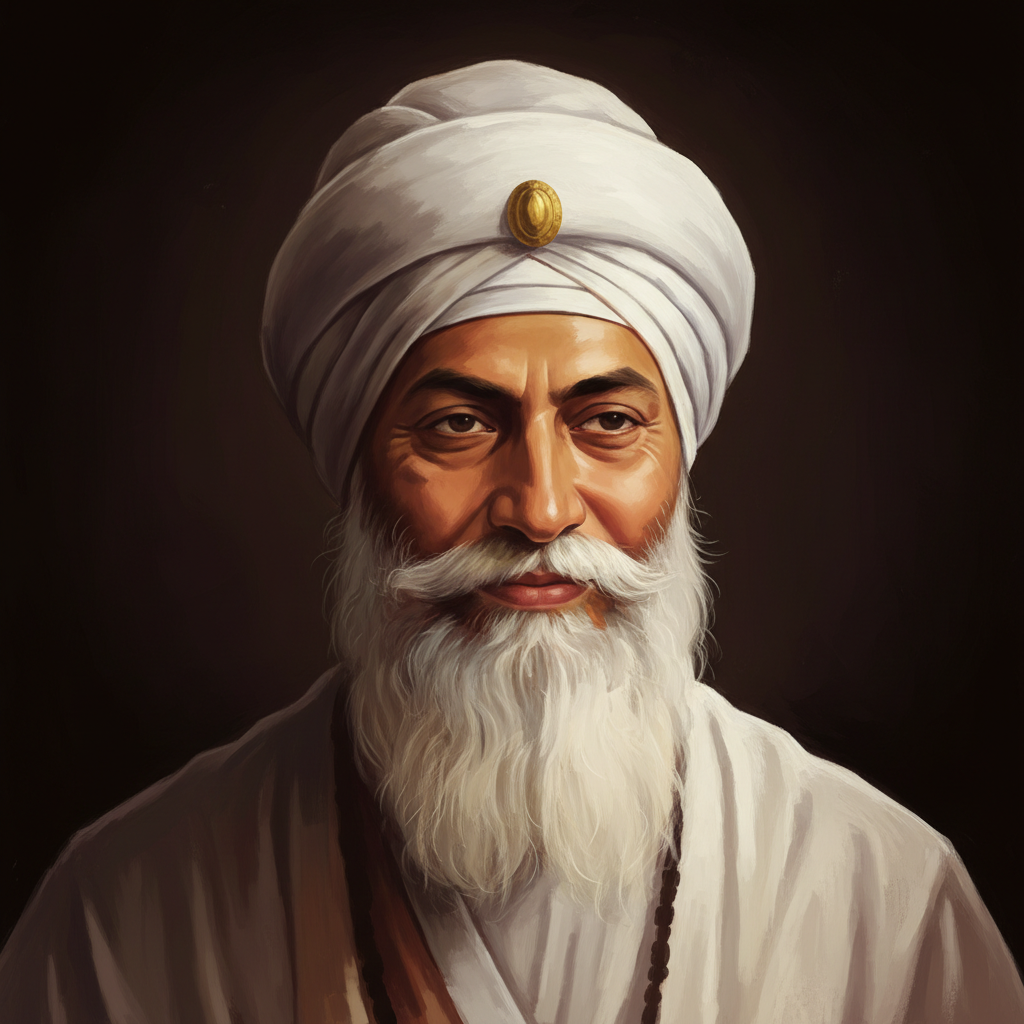
Guru Nanak — "The Lord Himself is the enjoyer, and He Himself is the enjoyed."
The Lord Himself is the enjoyer, and He Himself is the enjoyed.
The Lord Himself is the enjoyer, and He Himself is the enjoyed.
Click any product to generate a realistic preview. Up to 3 at a time.
* Initial load can take up to 90 seconds — revising the preview in another color is nearly instant.
"Live a life of honesty and integrity. And try not to spill your tea on yourself."
"Speak only that which will bring you honor."
"The True Guru is the Giver of peace and tranquility."
"Do not wish evil for others. Do not speak ill of others. Do not obstruct anyone's activities."
"The greatest joy is to be found in the Lord's Name."
Founder of Sikhism and the first of the Ten Sikh Gurus, whose teachings of one universal God and rejection of caste shaped Punjab. Closely associated with Kabir (mystical poet whose verses appear in the Sikh Guru Granth Sahib). For an intellectual contrast, see Brahmanical orthodoxy, the Hindu caste-and-ritual establishment of his era — Sikhism was founded as a deliberate alternative to both Hindu ritual hierarchy and Islamic exclusivism — Nanak's universalism was a structural rejection of caste and priestly mediation.
Found in 1 providers: grok
1 source checked
Everything you experience and everything experiencing it comes from the same divine source. The person tasting food, the food itself, and the pleasure of tasting are not three separate things but one reality expressing itself in different forms. Duality between enjoyer and enjoyed dissolves when you recognize that one ultimate consciousness animates both sides of every experience, making the universe a self-interacting whole rather than a collection of separate objects.
Guru Nanak founded Sikhism on radical monotheism called Ik Onkar, meaning One Universal Creator present in all things. As a traveling teacher who walked thousands of miles through India, Arabia, and Tibet, he rejected caste, ritual, and the Hindu-Muslim divide. This saying captures his central insight that the Divine is not distant but is simultaneously the experiencer, experience, and object within every creature, a teaching he sang through hymns now preserved in the Guru Granth Sahib.
Guru Nanak lived 1469 to 1539 in Punjab during intense Hindu-Muslim friction under the Lodi Sultanate and the arrival of Mughal emperor Babur, whose invasions Nanak personally witnessed and criticized. Religious identity was rigidly policed through caste rules, temple access, and forced conversions. Teaching that one God was both enjoyer and enjoyed directly undercut sectarian boundaries, ritual purity, and priestly gatekeeping, offering a unifying mystical vision during a period of political violence and spiritual fragmentation.
AI-generated insights based on extensive research and information for context. Factual errors? Email [email protected].
Your cart is empty