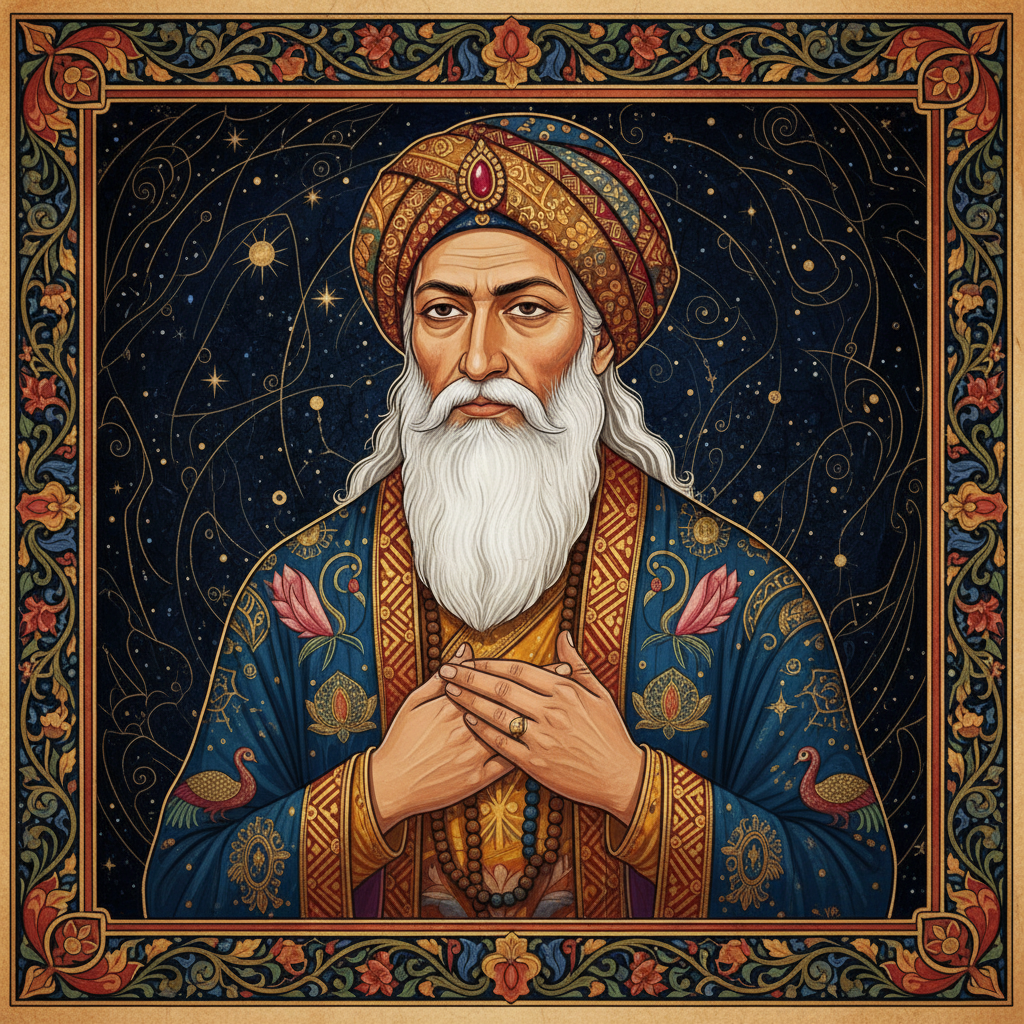
Kabir — "The mirror teaches: what we see is often what we bring."
The mirror teaches: what we see is often what we bring.
The mirror teaches: what we see is often what we bring.
Click any product to generate a realistic preview. Up to 3 at a time.
* Initial load can take up to 90 seconds — revising the preview in another color is nearly instant.
"The pearl is found in the shell, and the shell is in the sea. But the pearl is not the shell, nor the sea."
"Even a quiet heart shapes the world with its hidden song."
"When the mind is quiet, then the body is quiet. When the body is quiet, then the soul is quiet. When the soul is quiet, then God is quiet."
"The middle path is the way of wisdom."
"The river and its waves are one surf: where is the difference between the river and its waves? When the wave rises, it is the water; and when it falls, it is the same water again. Tell me, Sir, where …"
Indian mystic poet whose verses (preserved in the Sikh Guru Granth Sahib and the Hindu Bhakti tradition) attacked both Hindu and Islamic orthodoxy. Closely associated with Guru Nanak (founder of Sikhism, who incorporated Kabir's verses). For an intellectual contrast, see Brahmanical priesthood, the ritualistic Hindu establishment of his era — Kabir's poetry is the founding text of bhakti devotional rebellion against ritualistic Hinduism — his verses ridicule caste, ritual purity, and priestly mediation as religious theatre.
Emphasizing projection and subjective reality, from his poetry (Dohas).
Date: 15th Century
EducationalFound in 1 providers: gemini
1 source checked
Your cart is empty