Rachel Carson — "The more clearly we can focus our attention on the wonders and realities of the …"
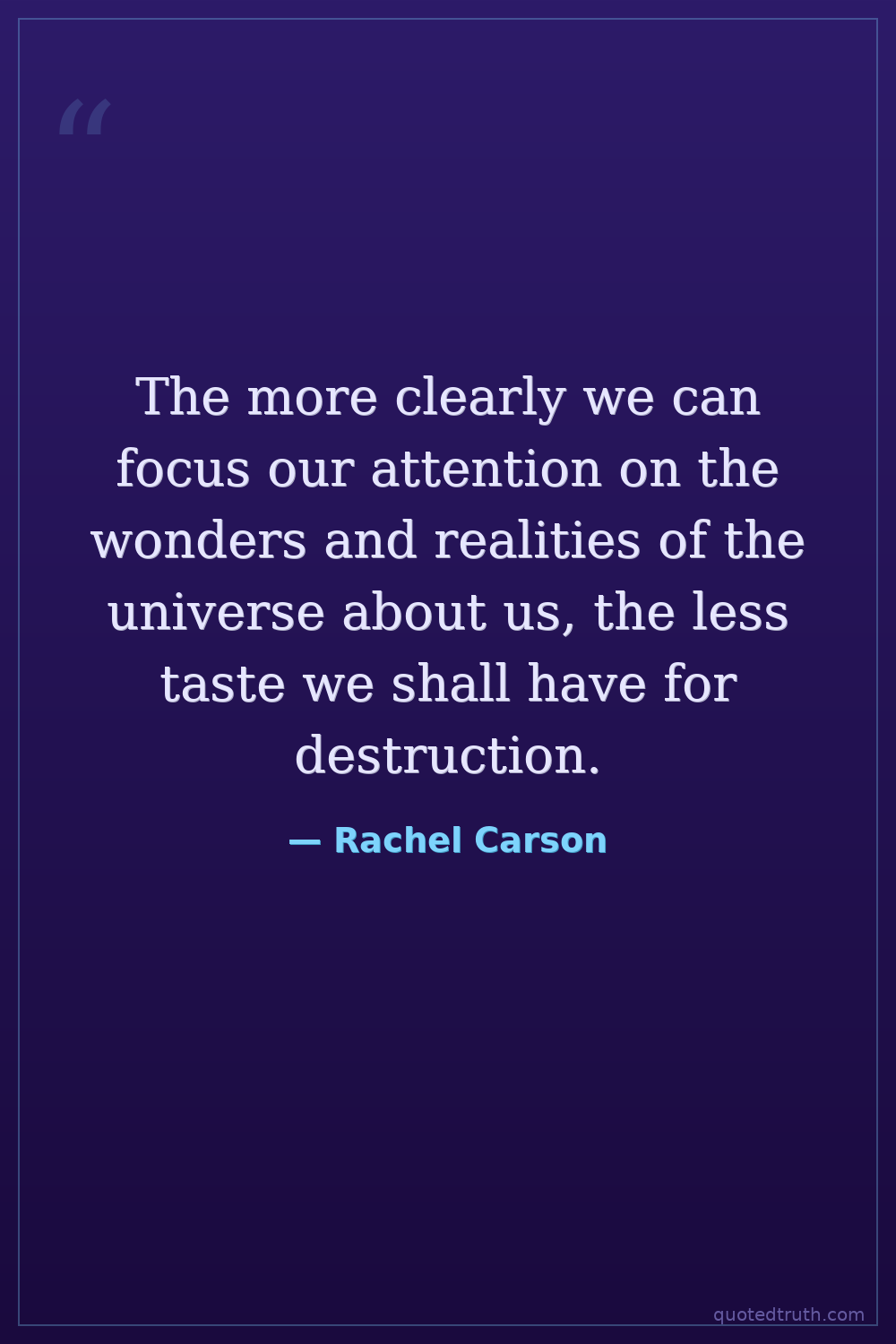
The more clearly we can focus our attention on the wonders and realities of the universe about us, the less taste we shall have for destruction.
The more clearly we can focus our attention on the wonders and realities of the universe about us, the less taste we shall have for destruction.
Click any product to generate a realistic preview. Up to 3 at a time.
* Initial load can take up to 90 seconds — revising the preview in another color is nearly instant.
"We are dealing with the most dangerous substances in the world, and we are treating them with a casual indifference that borders on criminal."
"I am not advocating for a return to the Stone Age, but for a more responsible approach to our use of technology."
"The human race is challenged more than ever before to demonstrate our mastery, not over nature but of ourselves."
"The edge of the sea is a strange and beautiful place."
"We are not to be a generation that leaves behind nothing but a devastated planet."
Found in 2 providers: grok,deepseek
2 sources checked
Paying close attention to the natural world — its beauty, complexity, and truth — naturally diminishes our desire to damage it. Wonder crowds out destruction. When we genuinely see what surrounds us, we develop reverence rather than indifference. Environmental harm thrives in the absence of attention, and cultivating awareness is itself a form of protection against the impulse to exploit or eliminate what we never bothered to understand.
Carson spent her career translating scientific observation into emotional connection. As a marine biologist and nature writer, she believed people destroy only what they fail to truly see. Silent Spring didn't just expose DDT's dangers — it forced readers to witness dying songbirds and poisoned waterways. Her earlier works, The Sea Around Us and The Edge of the Sea, were built on the conviction that loving attention to nature is the foundation of its defense.
Carson wrote during postwar America's chemical revolution — DDT was sprayed over neighborhoods, nuclear tests contaminated oceans, and industry treated nature as raw material for progress. The 1950s–60s celebrated technological conquest over the environment. Silent Spring (1962) was the first major public challenge to that worldview. Her quote captures the era's core problem: industrial society routinely destroyed ecosystems it had never stopped long enough to observe or value.
AI-generated insights based on extensive research and information for context. Factual errors? Email [email protected].
Your cart is empty