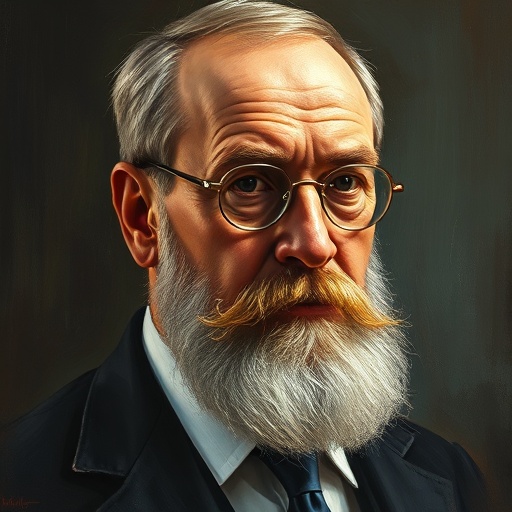
Robert Koch — "The more we know about microorganisms, the better equipped we are to combat them…"
The more we know about microorganisms, the better equipped we are to combat them.
The more we know about microorganisms, the better equipped we are to combat them.
Click any product to generate a realistic preview. Up to 3 at a time.
* Initial load can take up to 90 seconds — revising the preview in another color is nearly instant.
"The time has come when we can look forward to the eradication of tuberculosis."
"As soon as I had found the tubercle bacillus, I found it also in the sputum of phthisical patients."
"The idea that diseases of humans and animals are fundamentally different is erroneous."
"The more we learn about bacteria, the more we realize their complexity."
"The greatest obstacle to progress is not ignorance, but the illusion of knowledge."
Found in 1 providers: grok
1 source checked
Knowledge about pathogens directly translates to power over disease. Understanding how microorganisms function, reproduce, and spread enables development of targeted treatments, vaccines, and prevention strategies. Ignorance leaves populations defenseless; rigorous scientific investigation is the prerequisite for effective medicine. The deeper our grasp of an enemy's biology, the more precisely we can disrupt it — making research not an academic luxury but a survival necessity.
Koch embodied this belief throughout his career. In 1882, he isolated Mycobacterium tuberculosis after developing new staining and culture techniques, proving that precise identification of a pathogen was the first step toward defeating it. He also isolated the cholera bacillus and formulated Koch's Postulates — a rigorous framework linking specific microbes to specific diseases. His laboratory discipline showed that without exact knowledge, treatment was guesswork; with it, targeted medicine became possible.
Koch worked during the late 19th century, when germ theory was still contested and miasma — 'bad air' — remained the prevailing disease explanation. Industrialization packed workers into crowded cities, making tuberculosis, cholera, and typhoid epidemic killers. Bacteriology was a newly emerging science; microscopy and culture techniques were just maturing. Koch's discoveries in the 1880s came amid fierce scientific rivalry with Pasteur, transforming medicine from symptom management into microbe-targeted treatment.
AI-generated insights based on extensive research and information for context. Factual errors? Email [email protected].
Your cart is empty