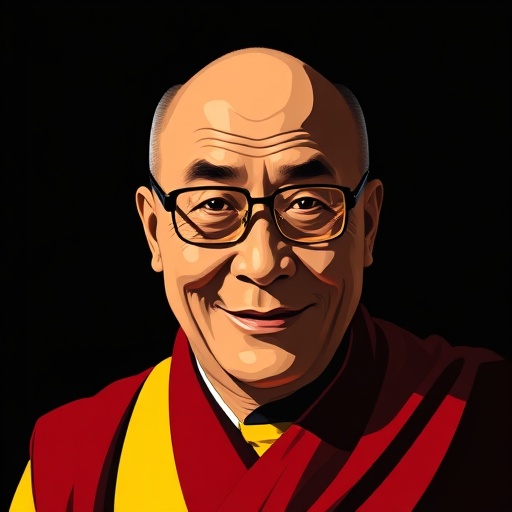
Dalai Lama (14th) — "The more you are motivated by love, the more fearless and free your action will …"
The more you are motivated by love, the more fearless and free your action will be.
The more you are motivated by love, the more fearless and free your action will be.
Click any product to generate a realistic preview. Up to 3 at a time.
* Initial load can take up to 90 seconds — revising the preview in another color is nearly instant.
"I am a strong believer in education. Education is the key to a better future."
"I am a professional laugher."
"I sometimes call myself a 'troublemaker' because I like to challenge people's assumptions."
"I am a simple Buddhist monk, nothing more. But I try my best to serve humanity."
"Be kind whenever possible. It is always possible."
Found in 1 providers: grok
1 source checked
When love—genuine care for others rather than self-interest—drives your choices, fear loses its grip. Fear comes from protecting yourself: your reputation, safety, or outcomes. Acting from love shifts your focus outward, removing the calculating anxiety about personal cost. You act clearly and decisively because you're not weighing what you stand to lose. Freedom follows naturally when love, not fear of consequences, is your compass.
Tenzin Gyatso has lived this principle under extreme pressure. Since China's 1950 occupation of Tibet and his 1959 exile, he chose compassion over retaliation—advocating nonviolence while his people suffered. He publicly forgave Chinese leaders who destroyed thousands of monasteries. The Nobel Peace Prize committee recognized this in 1989. His Middle Way approach—negotiation over armed resistance—is the direct political expression of love-driven, fearless action.
Born in 1935 and exiled in 1959, the Dalai Lama has navigated Cold War geopolitics, the Cultural Revolution's destruction of Tibetan culture, and post-9/11 fear-driven global politics. In an era when world powers respond to threat with force and surveillance, his message challenges governments and individuals alike. The global mindfulness movement of the 1990s–2000s amplified his voice, making this quote resonate far beyond Buddhism into mainstream psychology and leadership culture.
AI-generated insights based on extensive research and information for context. Factual errors? Email [email protected].
Your cart is empty