Bertrand Russell — "The most savage controversies are those about matters as to which there is no go…"
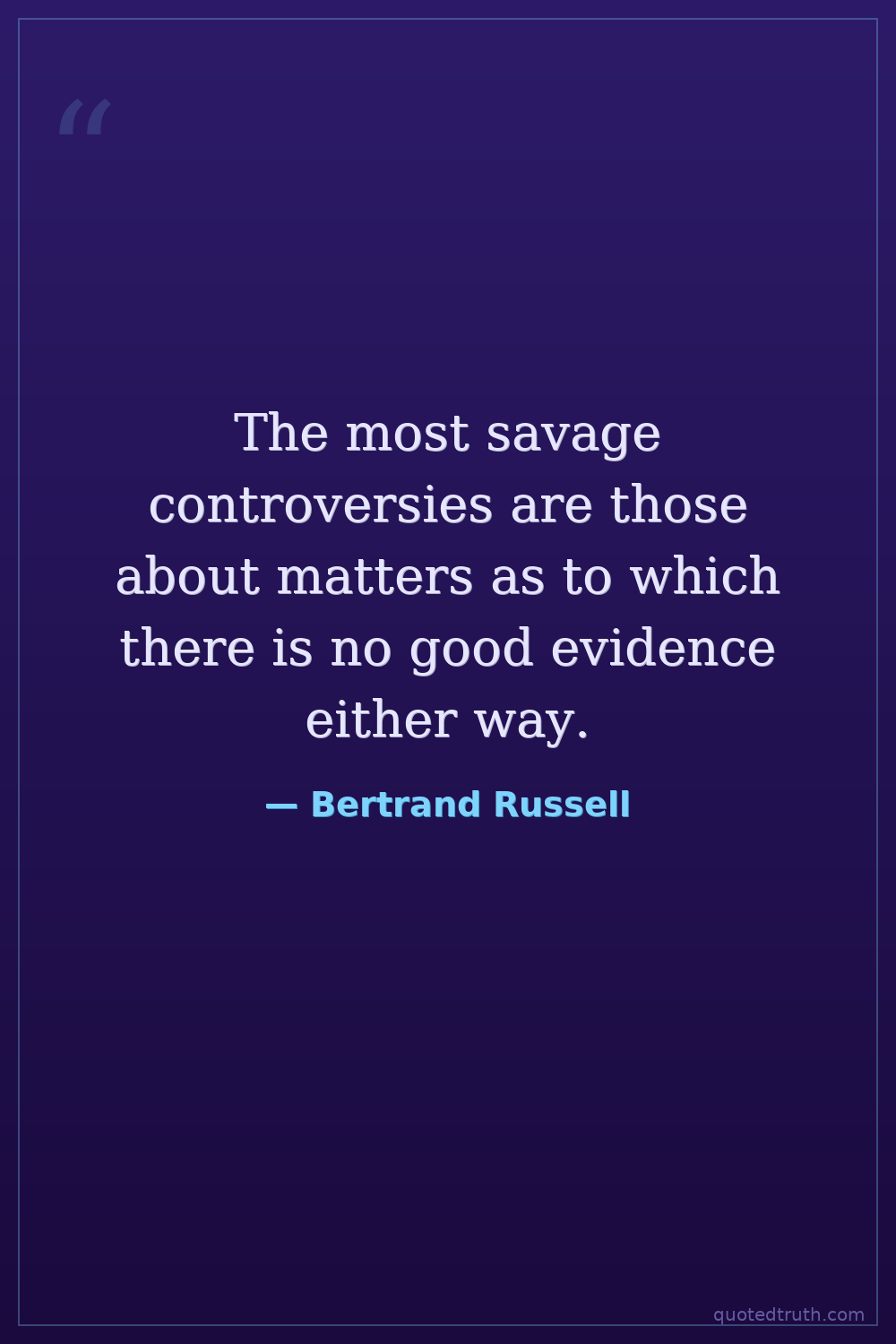
The most savage controversies are those about matters as to which there is no good evidence either way.
The most savage controversies are those about matters as to which there is no good evidence either way.
Click any product to generate a realistic preview. Up to 3 at a time.
* Initial load can take up to 90 seconds — revising the preview in another color is nearly instant.
"Three passions, simple but overwhelmingly strong, have governed my life: the longing for love, the search for knowledge, and unbearable pity for the suffering of mankind."
"The sections that are dwindling include the whole middle-class and the skilled artisans. The sections that are increasing are the very poor, the shiftless and drunken, the feeble-minded—feeble-minded …"
"The degree of a man's freedom is the measure of his intelligence."
"The more intense has been the religion of any period and the more profound has been the dogmatic belief, the greater has been the cruelty and the worse has been the state of affairs."
"The secret of happiness is to face the fact that the world is horrible, horrible, horrible."
British philosopher, logician, and Nobel literature laureate (1950) who co-authored Principia Mathematica with Whitehead and led 20th-century pacifist and nuclear-disarmament campaigns. Closely associated with Alfred North Whitehead (Principia Mathematica co-author) and Ludwig Wittgenstein (his student-then-rival). For an intellectual contrast, see F.H. Bradley, British Idealist philosopher — Russell's 1898 break with Bradley's neo-Hegelian Idealism — and his subsequent logical-atomism — is the founding moment of the Anglo-American analytic philosophy tradition that displaced Idealism for a century. Russell's entire early career is structured against Bradley's metaphysics of internal relations.
The standard scholarly entry points to Bertrand Russell's work: Ray Monk (Southampton, philosophy biographer) — Bertrand Russell: The Spirit of Solitude 1872-1921 (1996); A.C. Grayling (New College of the Humanities) — Russell: A Very Short Introduction (1996). These are the works graduate seminars cite when teaching Bertrand Russell.
Your cart is empty