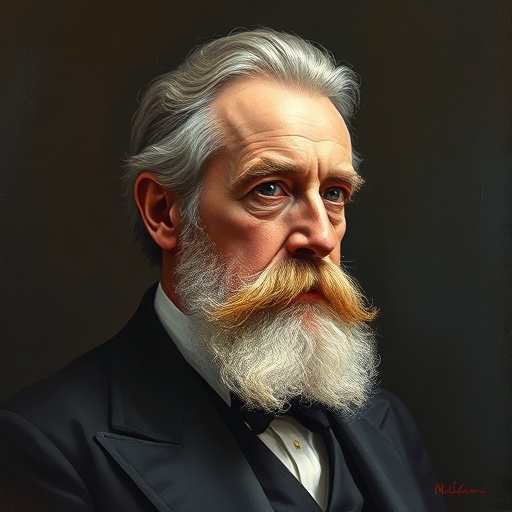
Alexander Graham Bell — "The nation that secures control of the air will ultimately control the world."
The nation that secures control of the air will ultimately control the world.
The nation that secures control of the air will ultimately control the world.
Click any product to generate a realistic preview. Up to 3 at a time.
* Initial load can take up to 90 seconds — revising the preview in another color is nearly instant.
"The most important thing for a man to do is to be true to himself."
"The deaf must hear, the dumb must speak, the blind must see."
"I had made up my mind to find that for which I was searching even if it required the remainder of my life. After innumerable failures I finally uncovered the principle for which I was searching, and I…"
"The day will come when the telephone will be used by every household in America."
"We are all too much inclined to follow the beaten paths of others, and it is only by striking out into new and untrodden ground that any discovery can be made."
Found in 3 providers: grok,deepseek,gemini
3 sources checked
Whoever dominates the skies—through military aircraft, surveillance, supply lines, or strategic positioning—holds an insurmountable advantage over nations confined to land and sea. Air control enables rapid force projection, intelligence gathering, and economic disruption anywhere on Earth. Aerial supremacy is not merely a military edge but the decisive factor determining which nation becomes the dominant global power.
Bell was far more than a telephone inventor—he was a lifelong aviation enthusiast. He co-founded the Aerial Experiment Association in 1907, helping develop the Silver Dart, one of Canada's first powered aircraft. He spent decades experimenting with kites and tetrahedral structures. His conviction that mastering new technology reshapes civilization—proven by the telephone—extended naturally to aviation, which he viewed as the next transformative force.
Bell made this observation in the early 1900s, just after the Wright Brothers achieved powered flight in 1903. Aviation was embryonic yet militaries were already racing to harness it. World War I (1914–1918) would soon validate his prediction through aerial dogfights and bombing campaigns. Competing colonial empires understood that mastery of new transportation and communication technologies would determine dominance in the coming century.
AI-generated insights based on extensive research and information for context. Factual errors? Email [email protected].
Your cart is empty