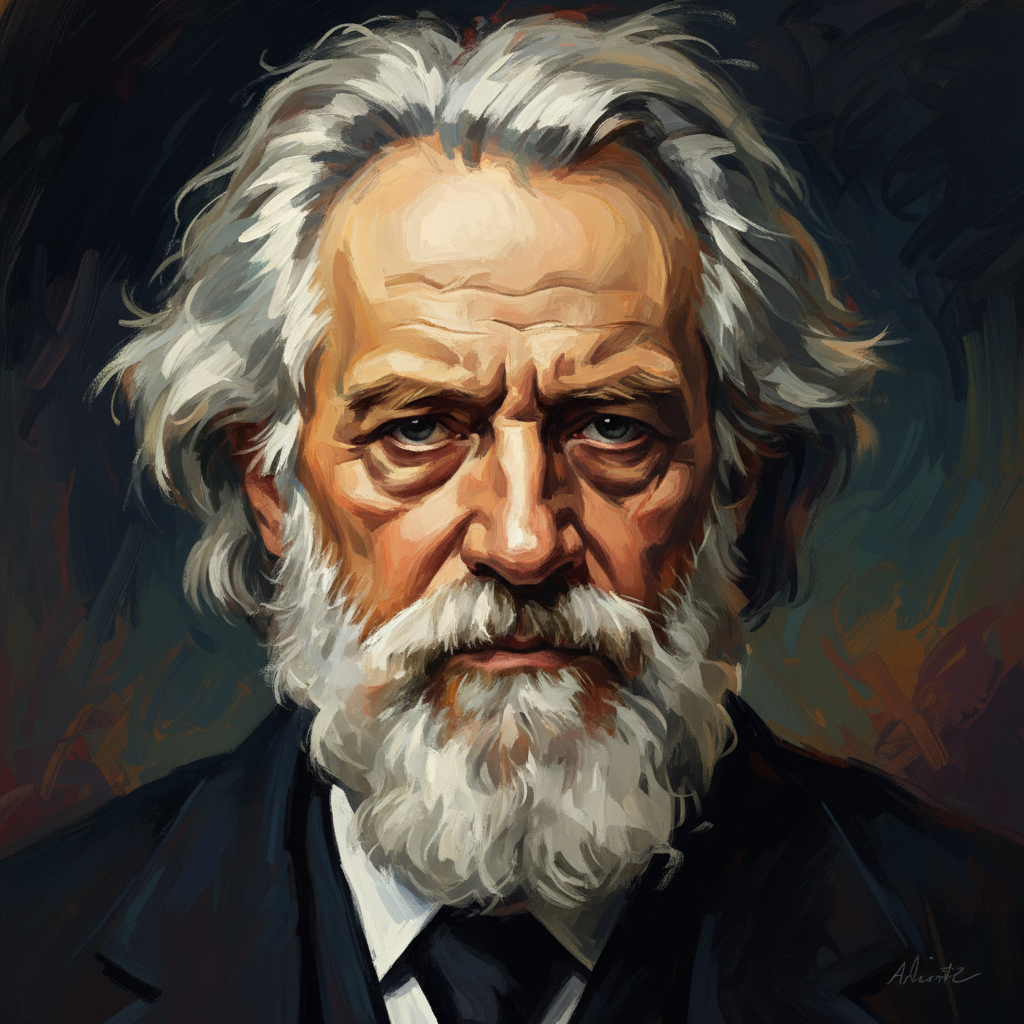
Arthur Schopenhauer — "The only original philosophical thought possible is the one that starts from the…"
The only original philosophical thought possible is the one that starts from the fact of suffering.
The only original philosophical thought possible is the one that starts from the fact of suffering.
Click any product to generate a realistic preview. Up to 3 at a time.
* Initial load can take up to 90 seconds — revising the preview in another color is nearly instant.
"A completely truthful woman who does not practice dissimulation is perhaps an impossibility."
"Just as the female ant after coition loses her wings, which then become superfluous, nay, dangerous for breeding purposes, so for the most part does a woman lose her beauty after giving birth to one o…"
"Marrying means, to grasp blindfolded into a sack hoping to find out an eel out of an assembly of snakes."
"We can regard our life as a uselessly disturbing episode in the blissful repose of nothingness."
"A man's face as a rule says more, and more interesting things, than his mouth, for it is a compendium of everything his mouth will ever say, in that it is the monogram of all this man's thoughts and a…"
German philosopher of pessimism whose The World as Will and Representation (1819) defined the suffering-and-renunciation tradition. Closely associated with Immanuel Kant (the system Schopenhauer built on and revised). For an intellectual contrast, see G.W.F. Hegel, German Idealist of the rational unfolding of Spirit — Schopenhauer scheduled his Berlin lectures opposite Hegel's and spent decades attacking Hegel's optimistic system as deliberately mystifying nonsense — the foundational rivalry of 19th-century German philosophy.
The standard scholarly entry points to Arthur Schopenhauer's work: Bryan Magee (Oxford, populariser-philosopher) — The Philosophy of Schopenhauer (1983); Christopher Janaway (Southampton, Schopenhauer specialist) — Self and World in Schopenhauer's Philosophy (1989); David E. Cartwright (Wisconsin–Whitewater) — Schopenhauer: A Biography (2010). These are the works graduate seminars cite when teaching Arthur Schopenhauer.
Your cart is empty