Linus Pauling — "The only thing that stands between a man and what he wants from life is often me…"
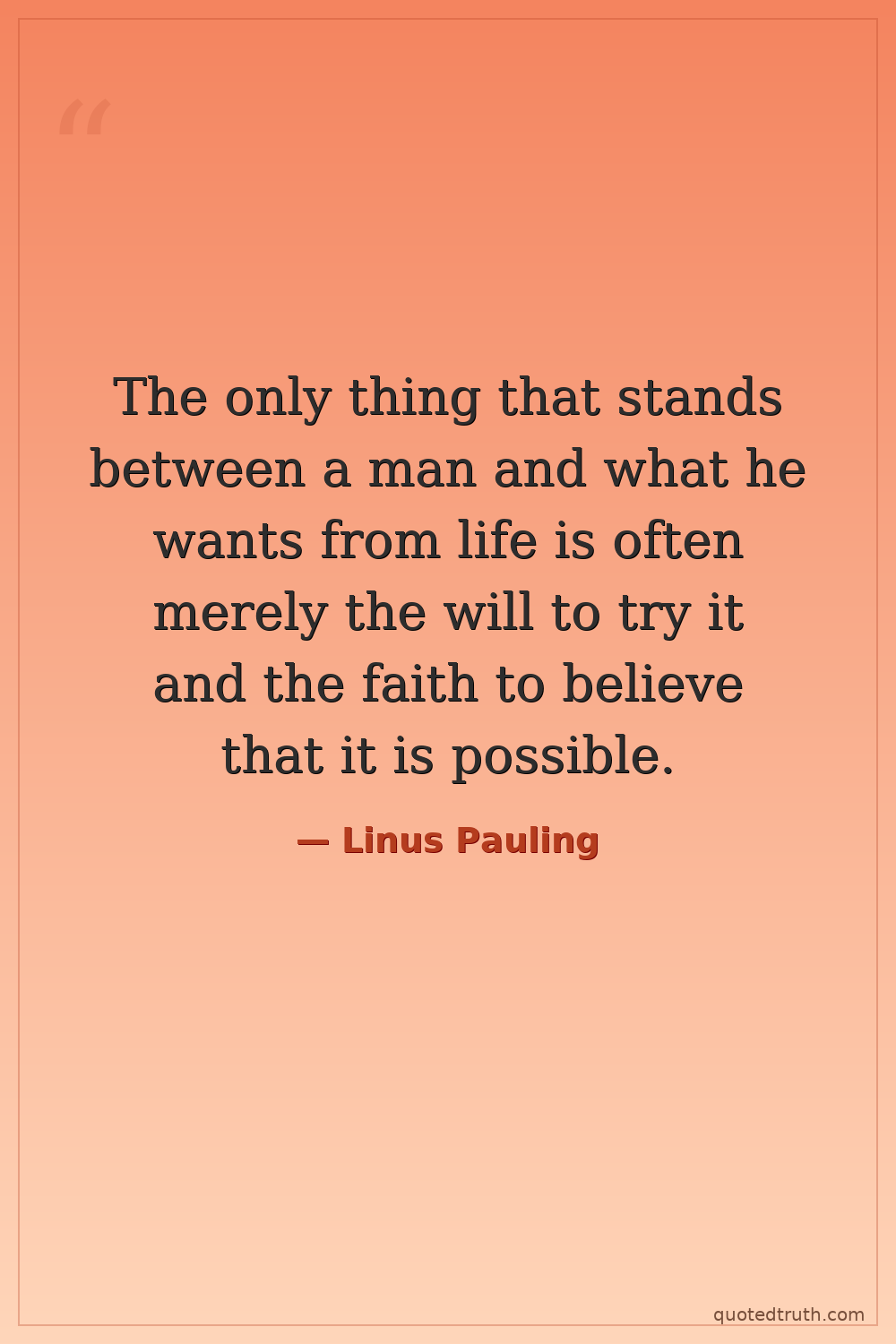
The only thing that stands between a man and what he wants from life is often merely the will to try it and the faith to believe that it is possible.
The only thing that stands between a man and what he wants from life is often merely the will to try it and the faith to believe that it is possible.
Click any product to generate a realistic preview. Up to 3 at a time.
* Initial load can take up to 90 seconds — revising the preview in another color is nearly instant.
"I am convinced that we can abolish war, and that we must do so if we are to survive."
"Just one living cell in the human body is, more complex than New York City."
"I believe that every human being has the potential to be a creative genius."
"The only way to do great work is to love what you do."
"The only way to discover the limits of the possible is to go beyond them into the impossible."
Found in 1 providers: grok
1 source checked
Success hinges not on talent, resources, or circumstance, but on two internal forces: the willingness to act and the belief that success is achievable. The quote strips away excuses and external blame, locating human achievement squarely in personal resolve. It argues that most failure is really a failure of attempt — that people stop themselves before obstacles even get the chance to.
Pauling lived this principle twice over. His quantum mechanical approach to chemical bonds defied entrenched classical models — he pressed forward despite skepticism and won the 1954 Chemistry Nobel. Then, at career peak, he pivoted to anti-nuclear activism during McCarthyism, enduring passport revocations and FBI scrutiny. His 1962 Peace Nobel validated both the courage to try and the faith that one scientist's dissent could matter.
Pauling's most active decades — the 1940s through 1960s — coincided with unprecedented scientific authority and Cold War conformity. Scientists were expected to serve national defense, not challenge it. American optimism about technology clashed with existential nuclear dread. Believing one individual will could reshape geopolitics — that a chemist's conviction could halt atomic tests — was a radical and costly faith that his career proved wasn't delusional.
AI-generated insights based on extensive research and information for context. Factual errors? Email [email protected].
Your cart is empty