What it means
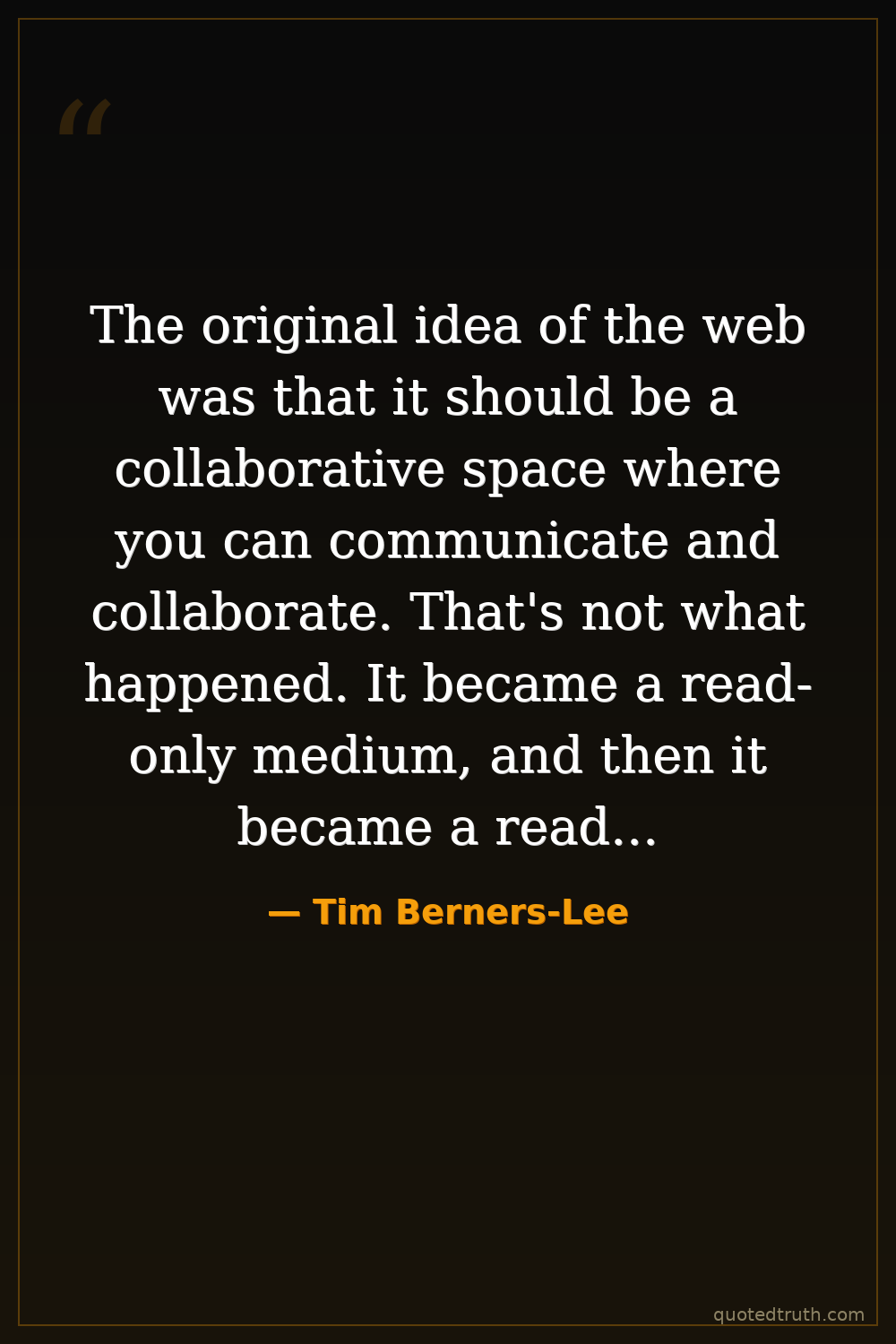
The web was meant to be a two-way space where everyone could read, write, and build together as equals. Instead it first became a place where most people only consumed content others published. Later, when posting and sharing became easy again, that activity got funneled through a handful of giant platforms. So the original promise of open, mutual participation was replaced by passive consumption and then by corporate-controlled interaction.
Relevance to Tim Berners-Lee
Berners-Lee invented the World Wide Web at CERN in 1989 and gave it away royalty-free, envisioning a decentralized network of linked documents anyone could edit. His later projects, including the Solid protocol and the World Wide Web Foundation, push back against platform lock-in by giving users control of their own data. This quote reflects his lifelong frustration that his open, collaborative blueprint was reshaped into something centralized, surveilled, and commercially gated.
The era
By the 2010s and 2020s, a small set of companies, Google, Meta, Amazon, Apple, Microsoft, dominated search, social, commerce, and cloud, harvesting personal data for targeted advertising. Concerns over misinformation, algorithmic feeds, monopoly power, and privacy scandals like Cambridge Analytica fueled debate about Big Tech. Movements around the fediverse, decentralization, and data ownership emerged as direct responses, the cultural backdrop in which Berners-Lee voices this disappointment.
AI-generated insights based on extensive research and information for context. Factual errors? Email [email protected].