What it means
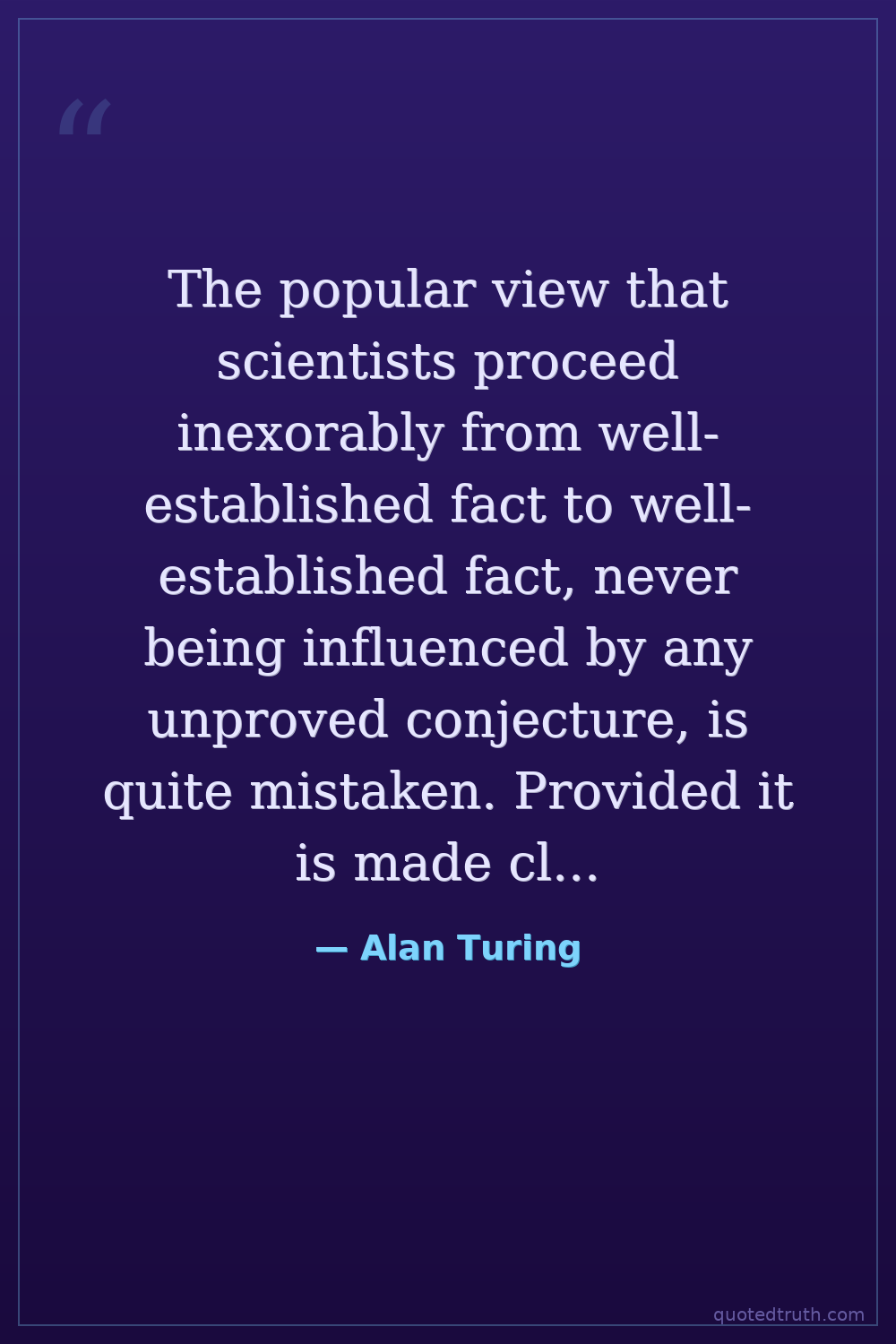
Science doesn't march forward only on certainty. Researchers routinely follow hunches, educated guesses, and unverified ideas — and that's legitimate, even necessary. The key requirement is honesty: label what's proven and what's speculative. Speculation isn't weakness; it points toward the experiments and investigations that eventually produce real knowledge. Intellectual progress depends on following promising guesses before proof exists.
Relevance to Alan Turing
Turing built his career on bold conjecture. His 1936 theoretical 'universal machine' was an unproven thought experiment before any computer existed. At Bletchley Park he pursued speculative cryptanalytic cribs others dismissed. His 1950 Imitation Game paper conjectured machine intelligence decades before evidence existed. He understood firsthand that transformative breakthroughs begin as unverifiable ideas someone was willing to take seriously.
The era
Mid-20th century science operated under a strict positivist ideology demanding observable proof before any claim mattered. The logical empiricist movement, dominant in academia, viewed speculation as pseudoscience. Yet this was simultaneously the era of quantum mechanics, information theory, and computing — all born from radical conjecture. Turing wrote at the precise moment when honesty about uncertainty was both professionally risky and scientifically essential.
AI-generated insights based on extensive research and information for context. Factual errors? Email [email protected].