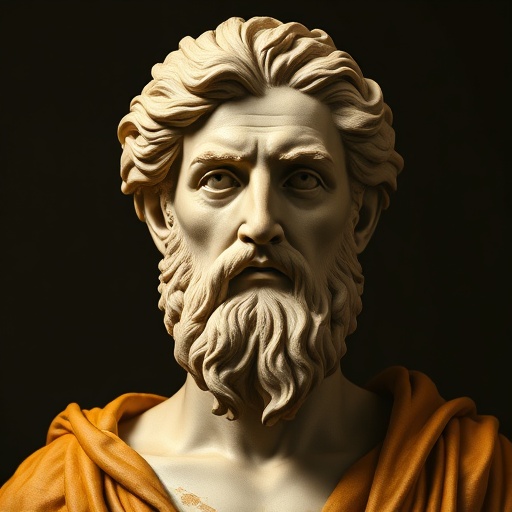
Archimedes — "The properties of bodies depend on their figures."
The properties of bodies depend on their figures.
The properties of bodies depend on their figures.
Click any product to generate a realistic preview. Up to 3 at a time.
* Initial load can take up to 90 seconds — revising the preview in another color is nearly instant.
"I have discovered a method by which any given solid may be weighed in water."
"Do not disturb my circles!"
"Every solid body immersed in a fluid is buoyed up by a force equal to the weight of the fluid displaced by the body."
"Noli turbare circulos meos."
"The value of pi is more than 3 10/71 and less than 3 1/7."
A fundamental insight into the relationship between form and function in physics.
Date: c. 250 BCE
GeneralFound in 1 providers: grok
1 source checked
Physical properties of objects — how they float, move, bear weight, or resist force — are determined by their geometric shape, not by mysterious essence or material alone. A sphere behaves differently than a flat slab of equal mass; a tapered lever multiplies force differently than a straight rod. Shape is the governing variable. This insight is now embedded in every branch of engineering, architecture, and physics.
Archimedes spent his career proving exactly this: he computed volumes and surface areas of spheres, cylinders, and parabolas, then showed these forms governed buoyancy, leverage, and projectile motion. He considered his greatest achievement proving a sphere's volume equals two-thirds that of its circumscribing cylinder — a geometric result with real physical meaning. His war machines exploited shape-based mechanical advantage to defend Syracuse against Rome for years.
In 3rd-century BCE Syracuse, Greek natural philosophy was shifting from abstract speculation toward mathematical rigor. Euclid had recently codified geometry in Alexandria, yet most thinkers still explained physical phenomena through elements, qualities, or divine will rather than geometry. Archimedes's insistence that shape determines physical behavior was a revolutionary methodological commitment, anticipating modern physics by nearly two millennia. Rome's sack of Syracuse in 212 BCE ended the ancient world's most productive scientific mind.
AI-generated insights based on extensive research and information for context. Factual errors? Email [email protected].
Your cart is empty